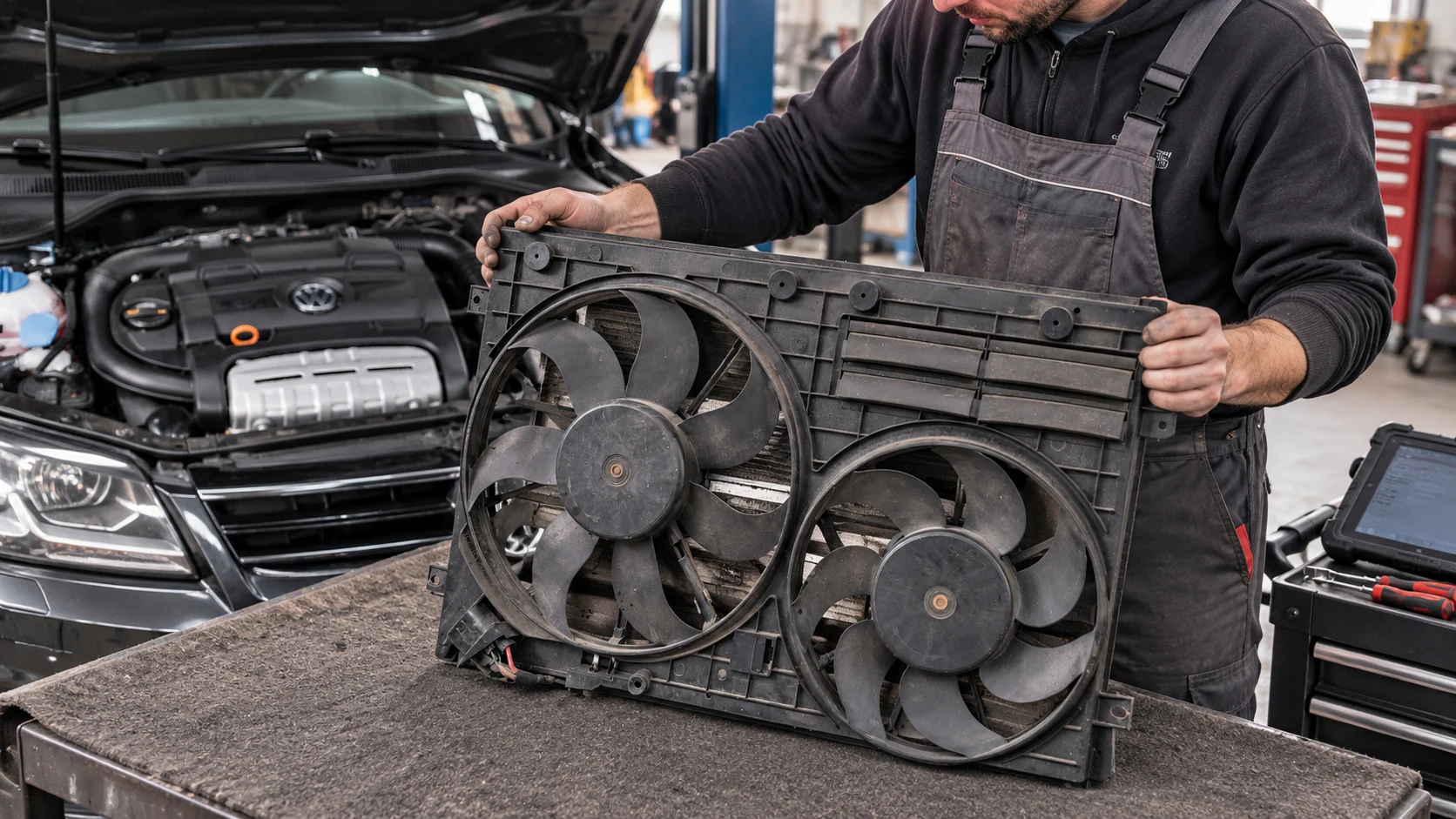
A Volkswagen cooling fan that keeps running after shutdown is not automatically defective. The important distinction is whether the vehicle is carrying out an intended after-run function or whether the fan is responding incorrectly, operating outside the applicable specification, or accompanying a cooling-system problem.
Short answer: occasional fan operation after switching off can be normal. Time the event and check the vehicle-specific information. Persistent operation, repeated battery discharge, damaged wiring, unusual mechanical noise or a temperature warning needs diagnosis rather than an automatic fan replacement.
This is a brand-level guide for combustion-engine Volkswagen vehicles. Cooling layouts, software, controller arrangements and emissions equipment differ. It is not a single wiring diagram for the entire brand, and it does not cover high-voltage cooling-system repairs on electric or hybrid vehicles.
Why a Volkswagen Cooling Fan May Run After Shutdown
Switching off the engine does not mean the cooling system has no remaining work to do. Heat remains in the engine compartment, while normal driving airflow has stopped. An electrically controlled fan can therefore be operated as part of the vehicle’s thermal-management strategy without the engine continuing to run.
Volkswagen addressed unnecessary fan replacement in Technical Bulletin 19 16 02, reference 2022549, dated October 20, 2016. For its covered applications, the bulletin describes after-run of up to 15 minutes for gasoline engines and 16 minutes for diesel engines, and calls for guided diagnosis when the specified period is exceeded.
Those are not universal limits for every Volkswagen. The historical bulletin covers specified 2005–2017 applications and includes an exclusion. Check its full applicability and current service information before using its figures. A vehicle outside that coverage needs its own specification; elapsed time also does not override a warning light or visible damage.
What about diesel particulate filter regeneration?
A republished Volkswagen TPI 2019342/8 links after-run in its described diesel situation to heat associated with particulate-filter regeneration. This is one possible operating context, not a diagnosis for every diesel fan complaint.
Fan noise alone cannot confirm regeneration, prove that the filter is healthy, or show that regeneration continues with the engine stopped. If a DPF warning is present, follow the Volkswagen warning-light guidance and the vehicle’s manual. Do not initiate a forced regeneration or follow a generic driving routine simply to stop the fan.

Normal After-Run or a Fault? Start With the Pattern
Record what actually happened before interpreting it. The same loud airflow can accompany normal cooling demand, an unusual sensor input or an electrical control problem. This comparison organizes the evidence without declaring one component faulty.
| Observed pattern | What it may indicate | Appropriate next step |
|---|---|---|
| Fan runs after a drive, then stops by itself; no other symptoms | Possible intended after-run | Record duration and conditions; compare with the applicable vehicle information. |
| Duration exceeds the specification for that vehicle | An operating condition or fault requiring investigation | Arrange diagnostic testing instead of applying an online universal time limit. |
| Fan behaves unusually after the vehicle has fully cooled | Temperature-input, command or electrical questions | Check fault memory, plausible live data and the actual control circuit. |
| Fan operation repeatedly leaves the battery unable to start the car | Excessive operation, weak battery or another electrical load | Assess the fan event, battery condition and resting-current behavior together. |
| Red coolant warning, steam or coolant escaping | A potentially urgent cooling-system problem | Stop safely, switch off and seek assistance; do not wait for a timer to expire. |
| Grinding, scraping, damaged blades or a heat-damaged connector | A mechanical or electrical safety concern | Have the assembly safely isolated and inspected before further operation. |
1. Time the Event Without Disturbing the Fan
Note the time the ignition was switched off, when the fan started if it was delayed, and when it stopped. Add the approximate journey length, weather, recent traffic conditions and whether the behavior is new. A short recording made from a safe distance can help distinguish airflow from scraping.
Keep children, loose clothing, hands and tools away. A stopped electric fan can start unexpectedly. The manufacturer workshop instructions reproduced here explicitly warn of automatic fan starting. Turning the ignition off is not a safe isolation procedure for physical inspection.
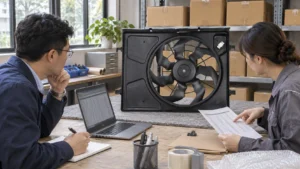
Identify the actual radiator fan rather than confusing it with a cabin blower or a pump. On the representative transverse-engine layout illustrated, the fan cowl is associated with the radiator at the front cooling module, on the engine side. Do not assume that access, fan count or arrangement is identical on every Volkswagen.
2. Check Warning Signs Before Calling It Normal
Volkswagen’s red cooling-system warning guidance directs the driver to stop as soon as it is safe and switch off the engine. Treat that warning as the priority, even when the fan is still running.
Allow the system to cool before any coolant-level check and follow the owner’s manual. Never remove a hot pressurized expansion-tank cap. Steam, escaping coolant, burning smells or damaged wiring also call for professional assessment rather than reassurance based only on the length of the fan cycle.
A running fan does not demonstrate that coolant is circulating correctly. Likewise, a normal-looking dashboard indication cannot answer every question about the temperature inputs being used by the controller. Keep the observed symptom and the underlying cause separate.
3. Read Fault Memory and Check Plausible Temperature Data
Before clearing codes or disconnecting components, have a workshop save the fault report and the conditions recorded with relevant faults. Use diagnostic equipment capable of accessing the applicable Volkswagen systems, not just reading a generic code description.
When the vehicle has fully cooled, compare available temperature readings with the surrounding conditions and with each other as appropriate for the system. Look for an implausible value or an abrupt change rather than assuming the sensor is bad because its name appears in a code.
HELLA’s coolant-temperature sensor guidance includes fault-memory checks and examination of wiring, connections, breaks and corrosion. A signal fault can originate in the circuit, not only inside the sensor. This guide deliberately supplies no universal resistance value or pin assignment.

4. Compare the Fan Command With the Actual Response
The next diagnostic question is simple: is the system requesting the observed fan operation? A genuine cooling request leads the investigation toward the reason for that request. A response that does not match the verified command leads toward the fan electronics, wiring and power-control path.
Volkswagen Tech Tip 19-12-04 describes a covered electronically controlled arrangement in which missing PWM control, while key-on supply is present, can produce constant fan operation. That makes an important point: continuous running does not by itself prove a failed motor.
The Tech Tip’s key-on condition is not a universal key-off test. Apply the correct wiring diagram, control strategy and diagnostic procedure to the vehicle in front of you. Do not transfer its connector numbering or duty-cycle examples to another assembly.
Record whether the complaint occurs with the vehicle asleep, awake or under a diagnostic test. A controlled workshop test and an untouched parked-car observation answer different questions. Avoid deciding that a controller is defective from one sound or one unverified scan-tool label.
5. Inspect the Supply, Grounds and Connectors Safely
With the correct isolation and access procedure, inspect the harness, connector locking, terminals, ground connections and signs of overheating or previous repair. If electrical measurements are required, a qualified technician should follow the circuit diagram and use methods appropriate to the load and control signal.
Do not assume every vehicle has a removable fan relay in the same location. Depending on the arrangement, control electronics may be integrated with the fan or provided separately. The parts catalog and wiring information must establish what is actually fitted.
Battery power at a fan connector after ignition switch-off is not, by itself, proof of a fault. Do not bridge random terminals, feed power into an unidentified control pin, or pull a fuse as a routine cure. A protection strategy or a legitimate cooling request must not be bypassed to make the noise disappear.

6. Investigate the Cooling Demand and Battery Complaint
If the controller is asking for fan operation, investigate the inputs and cooling conditions that justify or incorrectly create that request. HELLA’s cooling-system diagnostic overview includes coolant level and leaks, temperature plausibility, heat-exchanger airflow and fan control among the relevant checks.
For a repeated flat-battery complaint, document the actual fan running period and test the battery as well. Do not infer the cause of an overnight discharge from hearing the fan on one occasion. A workshop may need to evaluate resting current after the prescribed shutdown process and identify the load responsible.
The repair should address the verified cause. Replacing a fan that is correctly following an erroneous input leaves that input unresolved; replacing a sensor without checking its circuit can do the same.
When Is a Replacement Fan or Control Module Justified?
Replacement makes sense when testing identifies a failed motor, damaged fan wheel, defective integrated electronics, a separately serviceable controller fault or another confirmed assembly defect. It does not follow automatically from normal after-run.
Once a part is required, confirm the complete OE reference, including its suffix and any valid supersession. Match the vehicle’s engine, production date, market and cooling specification, then compare the connector, control arrangement, shroud and mounting interfaces. A single Volkswagen brand label cannot establish fitment.

For sourcing, browse our radiator fan category and radiator fan control module category. Send the original reference, vehicle details and clear photographs with your enquiry. A fitment review is separate from diagnosing why the original fan stayed on.
Frequently Asked Questions
Is it normal for a Volkswagen cooling fan to run after engine shutdown?
It can be. Compare a timed observation with the information for that exact vehicle and check for other symptoms before deciding that replacement is needed.
Is 15 minutes the normal limit for every Volkswagen?
No. The historical bulletin above has defined coverage and different gasoline and diesel guidance. It is not a specification for the entire brand.
Does a running fan prove that DPF regeneration is taking place?
No. Regeneration-related heat can be relevant on applicable diesel vehicles, but fan sound alone does not establish the filter’s operating state or condition.
Does continuous operation mean the fan relay is stuck?
Not necessarily. First identify the fitted system. Temperature inputs, control signals, wiring and the controller need to be considered; not every layout uses the same relay arrangement.
Should I disconnect the fan to protect the battery?
Do not disable it as a routine workaround or continue driving with required cooling disabled. If operation will not stop or the battery repeatedly discharges, arrange professional assistance and a vehicle-specific diagnostic check.
Image note: These AI-generated editorial scenes use real Volkswagen engine-bay and fan-assembly photographs as structural references. They are illustrative, not actual diagnostic results, universal installation diagrams or package-content photographs.