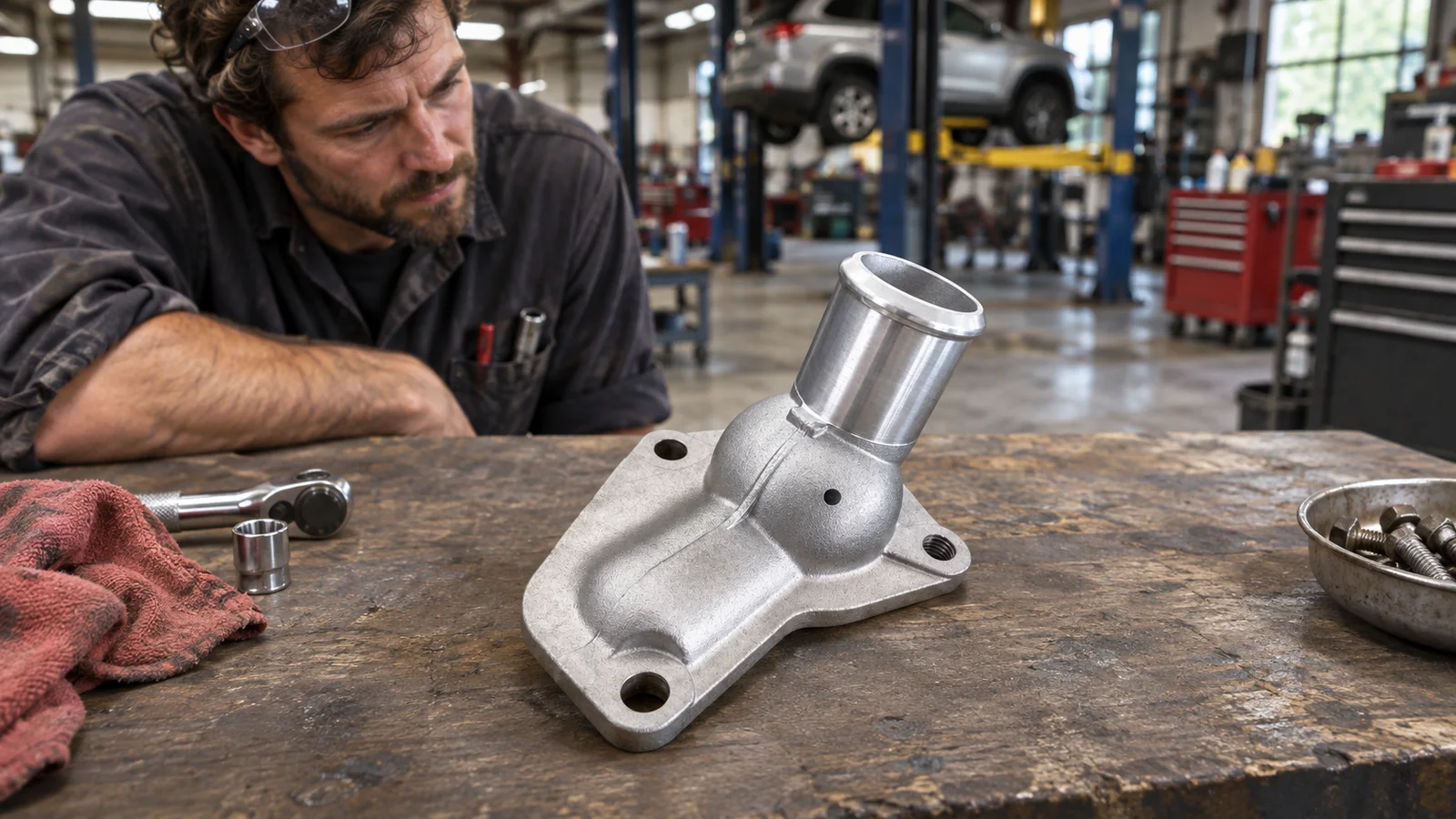
A thermostat housing leak does not automatically mean the housing is cracked. Coolant could be escaping from the gasket, a nearby hose connection or a component above the housing. The right repair depends on where fresh coolant first appears and which parts the vehicle manufacturer services separately.
Find the Leak Before Ordering Parts
Safety: Inspect with the engine off and fully cool. Never open a hot cooling system. If the vehicle overheats, emits steam or loses coolant rapidly, stop safely and arrange service rather than driving farther to reproduce the leak.
Look for the highest point where fresh coolant appears. Dried residue along the housing flange is a useful clue, but coolant from a hose above it can run down and leave the same mark. If the source is unclear, a workshop can pressure-test the cold system with the correct adapter, following the vehicle maker’s procedure and pressure limit. HELLA’s leak-testing guidance explains the purpose of a cooling-system pressure test.

| Confirmed leak source | What to check | Likely replacement |
|---|---|---|
| Housing-to-engine joint | Inspect the seal, housing flange and engine-side mating surface. | Gasket or O-ring only if it is serviceable separately and both surfaces are sound. |
| Crack through the housing or a molded outlet | Confirm coolant comes through the part itself, not from a joint above it. | Housing or complete thermostat assembly, depending on the design. |
| Hose, quick connector or connector seal | Check the hose end, connector and housing outlet separately. | Failed hose, connector or serviceable seal if the outlet is sound. |
| Joint still leaks after a new gasket | Check seal selection and seating, flange distortion and both mating surfaces. | Correct the underlying fault before ordering another seal or housing. |
When a Gasket or O-Ring Is Enough
A seal-only repair makes sense when the leak is confirmed at the sealed joint, the correct replacement seal is available separately, and the mating surfaces and seal groove are undamaged. Check the vehicle’s parts diagram: a housing-to-engine gasket is not necessarily the same as the seal between the thermostat and its housing. A HELLA repair example shows why identifying the exact joint matters.
A new gasket will not straighten a distorted flange or repair a damaged seal groove. If the damage is on the engine side, replacing the housing alone may not solve the leak either. Follow the manufacturer’s instructions for sealant, fastener torque and tightening sequence rather than tightening the bolts further to stop a seep.

When to Replace the Housing or Complete Assembly
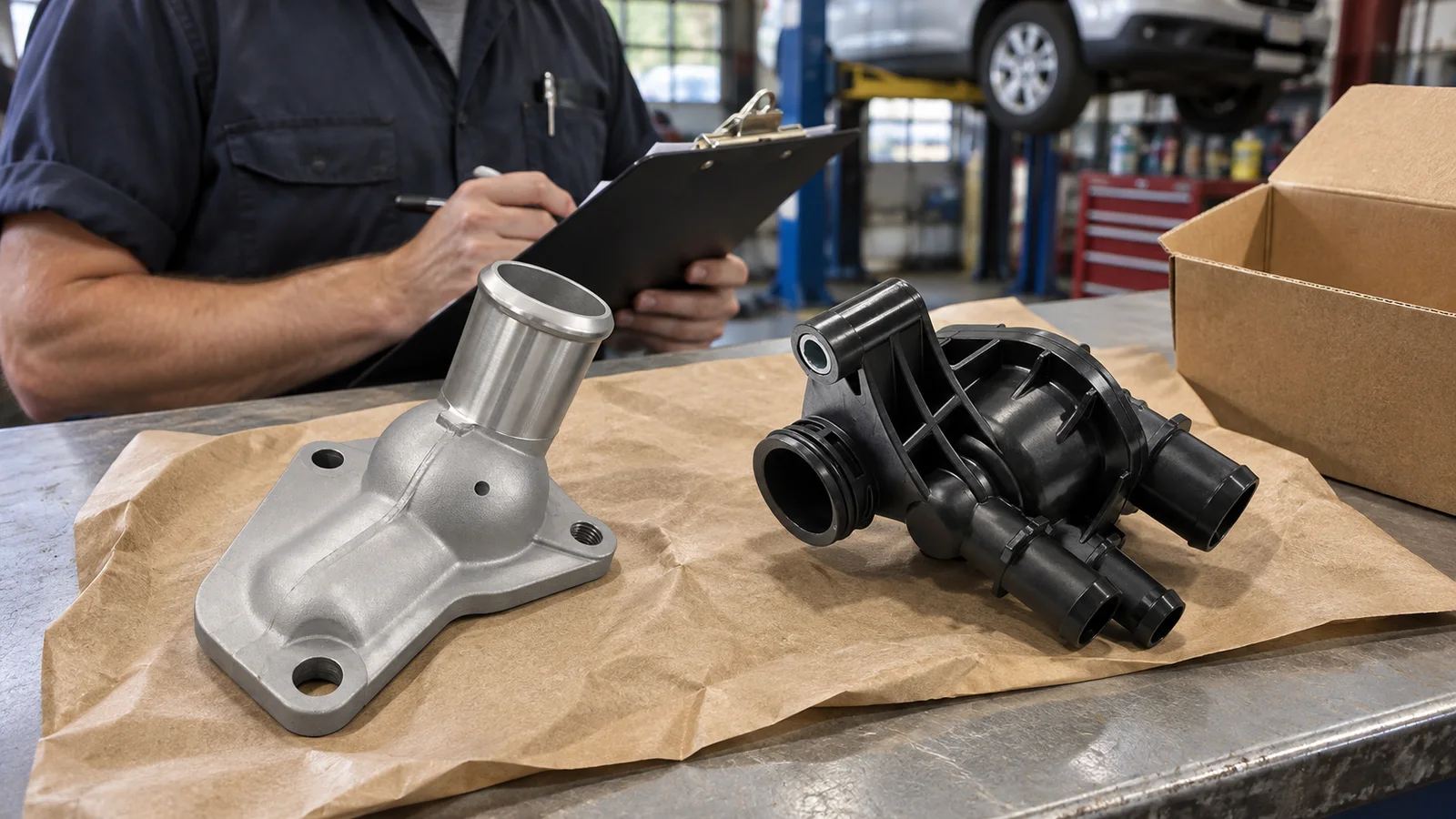
Replace the housing when a confirmed crack, warped sealing flange or damaged integral outlet prevents it from sealing. Before ordering, determine whether the thermostat can be serviced separately. Some applications use a bare housing and a removable thermostat; others use an integrated module. A listing that says “thermostat housing” does not tell you whether the thermostat, seal, sensor or other fittings are included.
Treat temperature complaints separately. A leaking housing does not prove the thermostat is stuck, and slow warm-up does not prove the housing leaks. If both coolant loss and temperature symptoms occur, verify the leak source and thermostat operation independently. See HELLA’s cooling-system diagnostic guide.

What to Confirm Before Buying a Thermostat Housing
For a fitment check or wholesale quote, send the full OE reference, vehicle and engine details, and photos of the original housing. Include views of the mounting flange, hose outlets and any sensor port or electrical connector. Ask the supplier to confirm:
- Whether the part is a bare housing or a complete thermostat assembly.
- Whether the gasket, O-ring, sensor and fittings shown are included or sold separately.
- Whether the quoted OE reference matches the original outlet orientation, mounting pattern and connector type where applicable.
Compare Yongshang Auto’s Toyota water inlet housing listing with its Ford thermostat housing assembly listing for examples of different layouts. They are not interchangeable. For a bulk order, add the quantity and destination market and request an itemized list of what comes in each box.
Frequently Asked Questions
Can I replace the thermostat housing gasket without replacing the thermostat?
Yes, if the seal is available separately, the mating surfaces are sound and there is no confirmed thermostat fault. Verify the service arrangement for the specific application.
Does dried coolant around the housing mean it needs replacement?
No. Residue can come from an old spill or a leak farther up. Locate fresh coolant before ordering either a gasket or a housing.
Does a replacement thermostat housing always include a gasket?
No. Check the package contents for the exact part number. A bare housing and a complete assembly may include different seals and fittings.
Images are AI-generated workshop illustrations based on catalog part geometry. They do not show a specific repair or guarantee fitment. Follow the applicable vehicle service information.