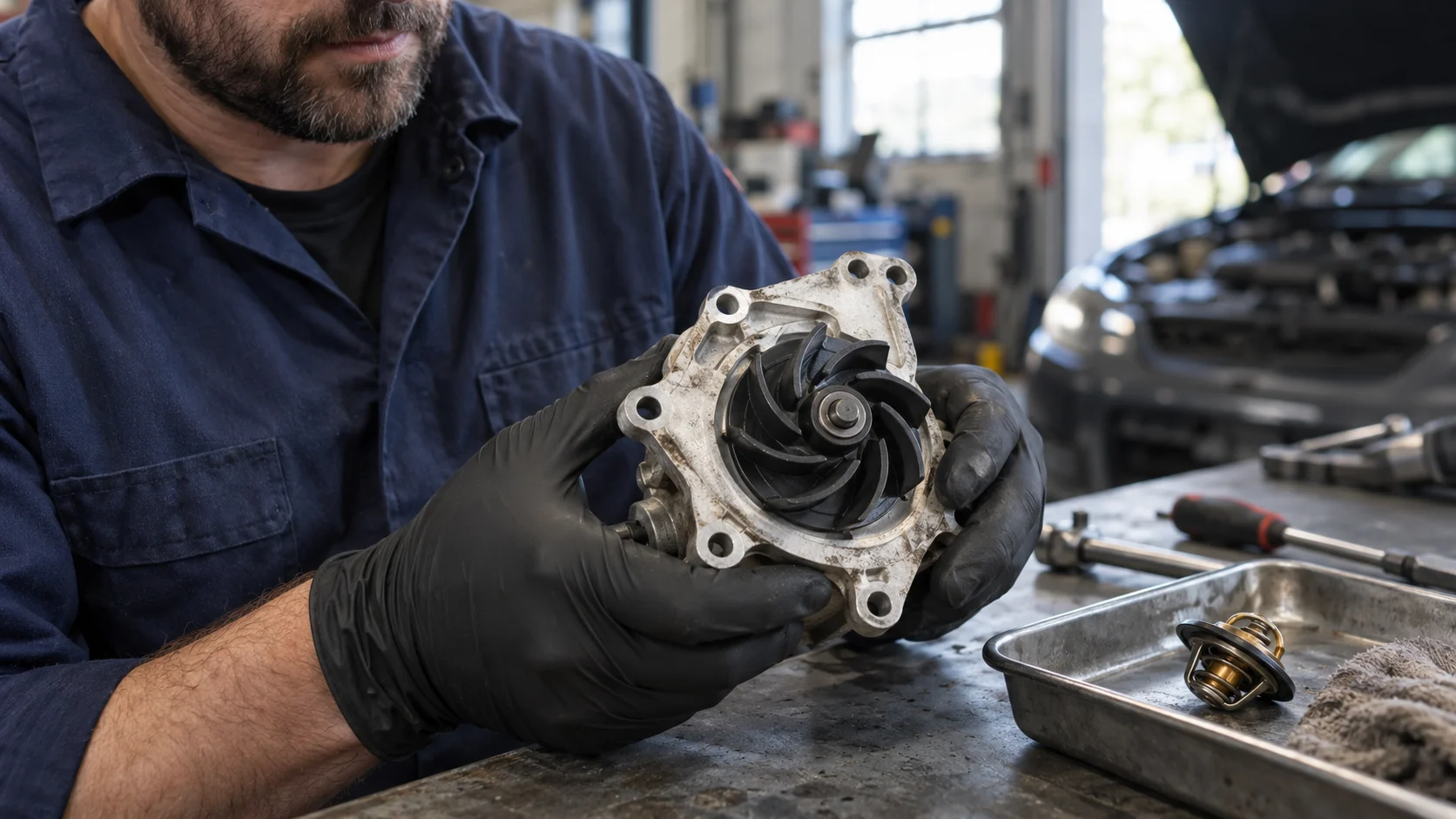
Water pump failure symptoms can include coolant loss, bearing noise and overheating. However, a rising temperature gauge does not identify the failed part. A thermostat that does not open, low coolant, restricted airflow or a combustion leak can produce a similar complaint.
The useful question is not simply whether the engine is hot. It is where coolant is escaping, whether circulation is working, and what evidence supports the diagnosis. This guide compares a bad water pump with thermostat and head-gasket faults, then explains what to verify before buying a replacement.
Before Diagnosis: Stop an Overheating Engine Safely
If the temperature warning appears, coolant is escaping or steam is visible, stop safely and follow the vehicle handbook. Do not keep driving to see whether the temperature settles. Never remove a radiator or pressurized expansion-tank cap while the engine is hot or running. Keep hands and tools away from belts and fans, which may start unexpectedly.
Check coolant level only under the conditions specified for the vehicle. Use the correct coolant specification, not color alone, when service is required. Ford’s coolant guidance explains the cold-engine inspection and hot-cap precautions.
Common Water Pump Failure Symptoms—and Their Limits
Coolant Loss or Residue Near the Pump
Look for a fresh leak trail, wet housing, repeated coolant loss or deposits around a sealing surface. Coolant can travel down from a hose, thermostat housing or another joint, so finding liquid near the pump is not the same as finding its source.
A water pump weep hole leak needs context. Minor dried residue is not an automatic replacement verdict. Subaru’s water-pump inspection bulletin distinguishes acceptable residue from leakage on its specified engines. Apply the relevant manufacturer’s criteria rather than transferring one model’s limits to every pump. Active dripping or falling coolant level warrants investigation.

Noise, Play or Drive Problems
A worn pump bearing can be noisy, but belt tensioners, idlers and other accessories can sound similar. On an appropriate mechanical-pump design, abnormal hub play or roughness supports further inspection after the drive has been safely isolated according to the service procedure. Do not diagnose by reaching toward a running belt.
Dayco’s overheating guidance identifies pump leakage and pulley problems as useful checks; overheating alone is not enough to condemn the pump.
Overheating Without an Obvious External Leak
A loose or damaged impeller can impair circulation even when the outside of the pump is dry. Therefore, a turning pulley does not establish that its impeller is working correctly. This follows from the internal failure modes described in HELLA’s coolant-pump overview.
Intermittent cabin heat may be an additional clue, but low coolant and trapped air can also affect heat output. Avoid replacing a pump based on heater performance alone.
Water Pump vs Thermostat Symptoms vs Head-Gasket Problems
Use this comparison to choose the next check, not as a parts-replacement decision by itself.
| Observed pattern | Possible explanation | Next useful check |
|---|---|---|
| Coolant appears near the pump | Pump seal, mounting joint or a leak above it | Trace the source; pressure-test as specified |
| Noise or play at a mechanical pump | Pump bearing or another belt-driven component | Safely isolate and inspect the drive |
| Engine warms unusually slowly | Thermostat remaining open, incorrect temperature reading or another control issue | Verify actual temperature and warm-up behavior |
| Engine overheats with inadequate radiator circulation | Thermostat not opening, pump fault, low coolant, air or restriction | Follow the vehicle’s temperature and circulation checks |
| Unexplained coolant loss with misfire or persistent exhaust symptoms | Possible internal coolant or combustion leakage | Professional combustion-leak and engine diagnosis |
| Pump-related electrical fault code | Power, wiring, control or electric-pump fault | Test the circuit and commanded response before replacement |
Confirm the Pump Type Before Testing It
A water pump may be driven by a timing belt, an accessory belt or another engine-specific arrangement; other designs use an electric motor. It may be integrated into the engine or installed elsewhere in the coolant circuit. Use the engine code and service information to identify the actual pump, drive and access procedure. Do not assume every pump is visible at the front of the engine.
For a mechanical pump, assess its drive, bearing, sealing surfaces and impeller as access permits. For an electric pump, check fault records, supply, ground, wiring and the response to an approved diagnostic command. A stored code identifies a diagnostic path, not necessarily a failed assembly. HELLA’s electric-pump troubleshooting guide illustrates this distinction. Do not power an unfamiliar pump directly or run it dry.
When the Thermostat Is the Better Lead
A thermostat that remains open can delay warm-up; one that fails to open can restrict the radiator flow path and contribute to overheating. Electronically controlled thermostats introduce additional circuit and control checks. These are different failure modes, as explained in Gates’ thermostat guidance.
Record coolant-temperature data and the temperature pattern around the thermostat using the vehicle’s procedure. Where appropriate, a removed thermostat can be tested against its specified opening characteristics. One hot hose and one cool hose, considered without warm-up stage, circuit layout and operating conditions, are not a complete diagnosis. Do not touch hot components to make this comparison.
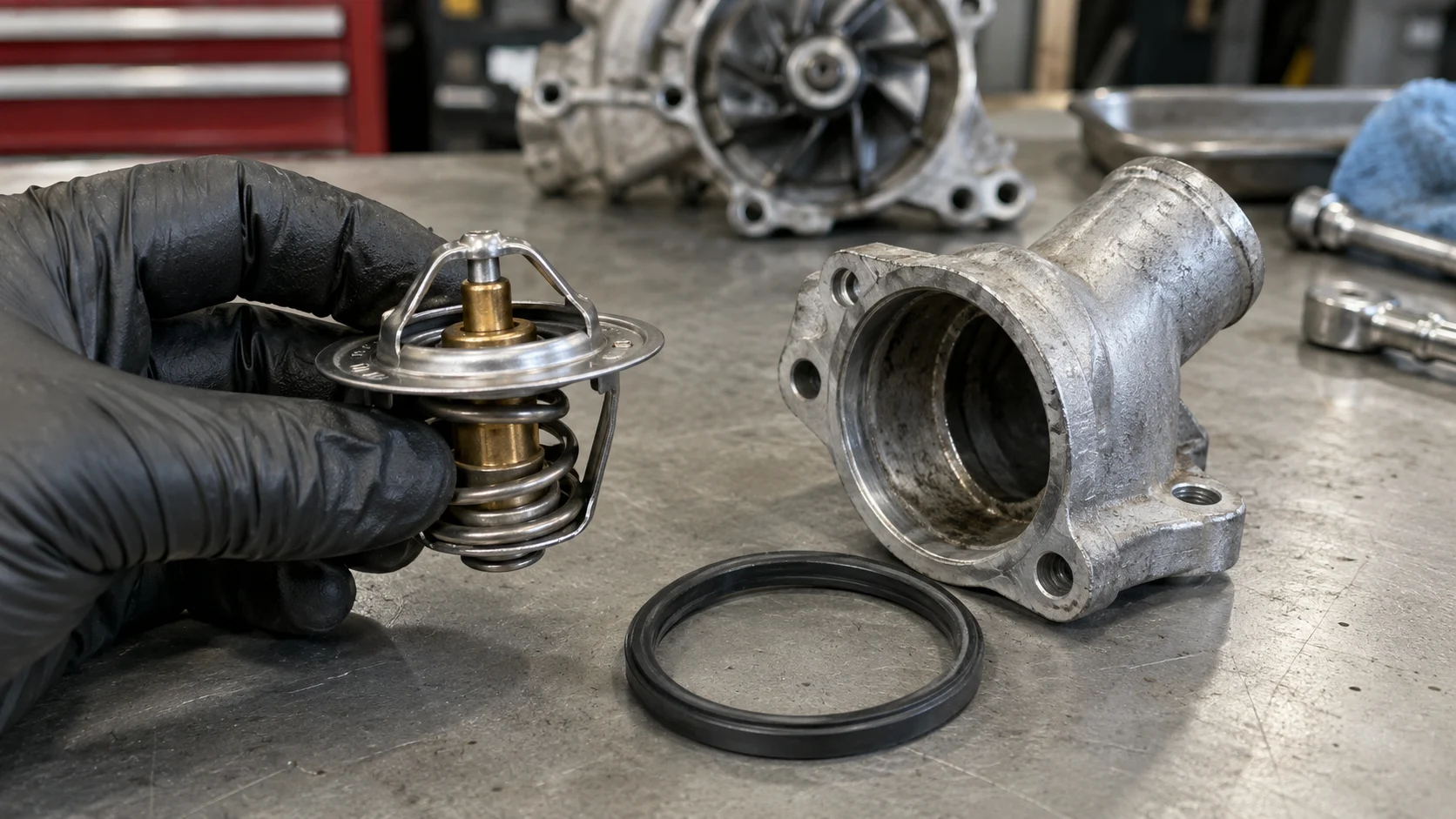
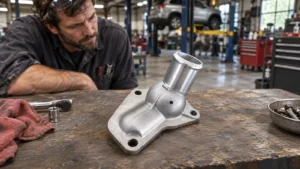
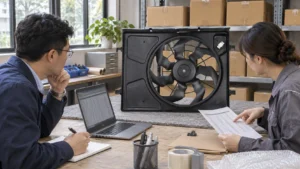
Also consider low coolant, trapped air, the pressure cap, radiator restriction and airflow. HELLA’s system-check sequence treats the pump and thermostat as parts of the whole cooling circuit. If the complaint mainly occurs at idle, our radiator fan guide covers the separate fan assembly and its requirements.
Water Pump or Head Gasket: What Changes the Diagnosis?
Unexplained coolant loss, repeated misfires, persistent abnormal exhaust vapor, oil/coolant contamination or suspicious cooling-system pressurization can justify investigating an internal engine leak. No single visual sign settles the diagnosis, and apparently clean oil does not establish that every internal sealing path is sound.
A head-gasket leak and a cracked cylinder head can produce overlapping symptoms. Fel-Pro’s diagnostic overview explains why component-level confirmation may require further engine inspection and cylinder-head testing.
The choice is not always either/or. A cooling fault can cause overheating that subsequently damages an engine seal. Replacing a leaking pump may therefore solve the original leak without correcting damage caused during the overheating event.
Pressure Testing and Combustion-Gas Testing Are Different
A cooling-system pressure test helps investigate coolant escaping from the system. Use the correct adapters, test pressure and procedure; do not substitute a universal PSI value. A static pressure test does not demonstrate correct pump flow or thermostat operation.
A chemical combustion-leak test samples gas above the coolant, not liquid coolant itself. A positive result supports exhaust-gas entry, but does not uniquely identify the head gasket: a cracked head or block can also be involved. Test conditions, intermittent faults and coolant contamination of the reagent can affect results. One negative check should not overrule continuing symptoms.
The Block Tester manufacturer’s FAQ explains these limitations and the different purpose of the two tests. Leave procedures involving a running engine or a hot cooling system to a trained technician following both equipment and vehicle instructions.

When Water Pump Replacement Is Justified
Replace the confirmed failed component: a defective pump seal or bearing, damaged impeller, or internally failed electric pump requires the applicable repair. A leak at a serviceable hose, seal or separate housing may call for a different part. Record the evidence before ordering.
Check the underlying cause and related service requirements. Contaminated coolant, incorrect sealing practices or drive problems can compromise a replacement. Where the pump is driven by the timing belt, assess the belt system and the manufacturer’s replacement requirements together. Use specified coolant, seals, fasteners and filling or bleeding procedures. Gates’ water-pump failure bulletin illustrates corrosion, deposits and other damage patterns that deserve attention.
Match the Replacement to the Engine, Not Just the Vehicle Name
- Confirm the OE reference, VIN or production data, and engine code.
- Match the mechanical drive arrangement or electric connector and control requirements.
- Compare mounting holes, sealing face, ports, hub offset and impeller clearance.
- Confirm whether the supply includes a housing, thermostat, gasket, O-ring or other required parts.

After the repair, complete the specified leak, temperature and operational checks. Recheck coolant level when cold as directed, and investigate returning warnings instead of assuming the new part has resolved every fault.
Frequently Asked Questions
Can a water pump fail without leaking?
Yes. Internal impeller or drive problems can reduce circulation without an obvious external leak; an electric pump can also have a control or electrical fault. Confirm function rather than judging the outside alone.
Does overheating mean the water pump is bad?
No. Check coolant level, leak sources, thermostat operation, radiator airflow and other relevant causes. Water pump failure symptoms overlap with several cooling-system problems.
Should I replace the thermostat whenever I replace the pump?
Not automatically on every vehicle. Follow the manufacturer’s repair guidance and assess the thermostat, integrated housing design and overheating history. Some assemblies combine functions; others are serviced separately.
Can I keep driving with a leaking pump?
Active leakage can reduce coolant and lead to overheating. Arrange diagnosis promptly. If there is overheating, steam, rapid coolant loss or a serious warning, stop safely and arrange assistance rather than continuing the trip.
Find the Correct Water Pump
Explore Yongshang Auto’s Water Pump category once the failed component is identified. If testing points elsewhere, check the Thermostat or Thermostat Housing category. Send the OE reference, vehicle and engine details, original-part photographs, quantity and destination for a fitment enquiry.
Images are AI-generated workshop illustrations, not photographs of a specific repair or product SKU. Pump designs, mounting locations and test procedures vary by vehicle. Use the exact vehicle’s service information.