Front grille replacement is not just a choice between black and chrome. Two grilles can look almost identical while using different camera mounts, emblem bases, attachment points or provisions for driver-assistance equipment. A part that clips into the bumper is not automatically compatible with every system behind it.
This guide explains how to check front grille fitment before ordering, what to compare when the replacement arrives, and why camera or radar work may require vehicle-specific checks after installation. It focuses on matching the grille assembly, not on repairing a cracked bumper.
Start with the Exact Vehicle and Front-End Package
Year, make and model narrow the search, but may not identify the correct grille. Check the VIN, production date, sales market, trim level, facelift version and exterior appearance package. A standard grille, sport version and camera-equipped version may have different service part numbers.
Record the original part number where available and have any superseded reference checked against an application catalog. Photograph both sides of the original grille, including its emblem area and mounting points. If the vehicle was previously modified, establish its original equipment specification rather than assuming the fitted grille is correct.
This is not only an aftermarket concern. A Ford front-grille listing specifically excludes certain camera and appearance-package configurations. Read application notes and exclusions, not just the model-year range.

Front Cameras: A Hole Is Only Part of the Match
Identify which camera the vehicle actually has. A front parking or surround-view camera in the grille is not interchangeable with a forward-facing driver-assistance camera near the windshield. Ford’s F-150 360-degree camera guide, for example, identifies a grille-mounted front-view camera. That location is an application-specific example, not a rule for every vehicle.
Check the Camera Opening, Bracket and Retention
When comparing a grille with camera hole provisions, ask for photographs of the opening and its rear mounting structure. Confirm the camera bracket reference, locating features, fasteners and intended orientation. A visible hole of roughly the right diameter does not establish that the existing camera will sit at the correct angle.
- Check whether the front camera grille bracket is included, transferred or ordered separately.
- Confirm that the intended lens view is not obstructed by a slat, trim ring or badge.
- Compare connector clearance and the original harness-retaining points.
- Where fitted, check the camera washer nozzle, hose and associated mounting provisions.
Do not enlarge an opening, improvise spacers or alter a bracket to make the camera appear to fit. Resolve an application mismatch before installation. A grille supplied with camera provisions does not necessarily include the camera, wiring or calibration service.
Radar Compatibility: Check More Than the Grille Shape
A front radar may sit behind an emblem, a dedicated cover or another area of the front fascia, depending on the vehicle. The grille is not always the radar’s mounting structure. Ford’s pre-collision sensor-location guidance shows one arrangement with the radar behind a lower-grille panel and the camera at the windshield. Use the relevant vehicle diagram to identify yours.
Separate three items when ordering: the electronic radar module, its support or bracket, and the cover through which it senses. A replacement decorative grille does not automatically supply all three. Nor does a matching bolt pattern prove that the material in front of the radar is suitable.
The Emblem Can Be a Functional Cover
Some emblems and bases are specifically designed for radar-equipped versions. Honda’s 2016 Pilot body-repair bulletin, page 10, distinguishes the radar-compatible emblem/base from the non-compatible version and describes a fault caused by fitting the wrong base. That example illustrates why an emblem’s appearance alone is not enough.
Confirm the applicable emblem and base references, supplier application evidence and vehicle-maker requirements. Do not describe a grille as radar compatible merely because it is plastic or has an emblem recess. Likewise, do not assume a cosmetic grille certification or general fitment statement covers every ADAS function.
Avoid unapproved paint, wraps, films, badges, filler or accessories in the radar sensing area. Hyundai’s front-radar precautions prohibit painting the sensor cover for the covered application and warn about nearby accessories. This does not mean every decorative grille surface has the same refinishing restriction: identify the specific cover and follow its instructions.

Inspect Grille Mounting Tabs, Clips and Surrounding Parts
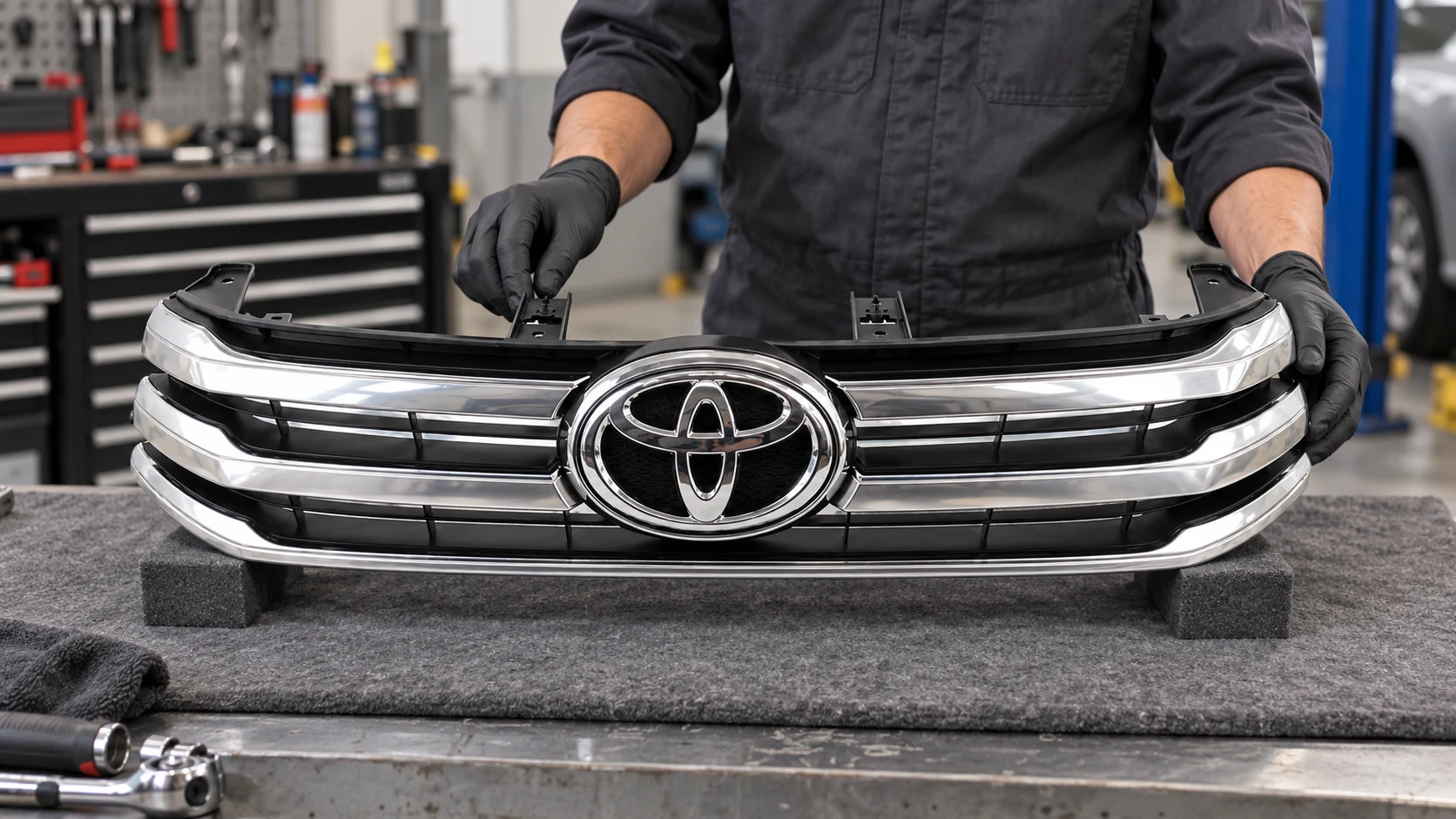
Compare the rear of the assemblies, not just the face. Count and locate the grille mounting tabs, screw bosses, locating pins, clip seats and support ribs. Check the relationship to the bumper cover, upper supports, trim and lamps. Similar overall width does not guarantee that these interfaces match.
After an impact, inspect the receiving brackets and adjacent supports as well. A correct new grille may sit unevenly because the structure receiving it is damaged. Do not use fasteners to pull a misaligned assembly into place or substitute makeshift restraints for the specified attachments.
Also identify air guides, seals or active grille shutters behind the visible trim where fitted. Verify clearance and whether they are separate service items. A cosmetic grille and an active shutter assembly are not the same product, even when a listing uses the word assembly.
Check every new part on receipt for broken tabs, transit distortion and missing hardware. Follow the service procedure for clip release, removal sequence and tightening specifications; there is no universal fastener count or torque value for front grille replacement.

Front Grille Replacement Compatibility Checklist
Use the following checks to build a written order specification. A photograph supports identification; it does not replace the correct application reference or repair procedure.
| Check | Evidence to provide or request | Do not assume |
|---|---|---|
| Vehicle version | VIN/build details, market, trim and OE reference | Every grille listed for the same year fits every package |
| Front-view camera | Opening, bracket reference, orientation and rear photographs | A camera hole includes the camera or correct bracket |
| Radar cover and emblem | Exact cover/base application and manufacturer requirements | Matching shape or color proves radar compatibility |
| Mounting system | Tabs, bosses, clips, supports and attachment locations | Overall dimensions alone establish fitment |
| Finish and trim | Specified finish, separate moldings and transfer requirements | All versions can be painted or wrapped in the same way |
| Adjacent assemblies | Air guides, seals, shutters and sensor/harness clearances | A grille assembly contains everything behind it |
| Package contents | Written supplied, reused and separately ordered parts list | Emblems, sensors, brackets and fasteners are included |
Make the package list explicit. For example, Dorman’s published grille-insert specifications distinguish a snap-in insert from its mounting hardware, which is not included in that application. Catalog terminology is not a substitute for a contents list.

Calibration After Grille Replacement: Check the Actual Repair
Plan sensor-related work before removing the grille. Whether aiming, alignment, initialization or calibration is required depends on the vehicle, the disturbed components and the manufacturer’s repair instructions. Do not use either blanket rule: every grille replacement needs the same calibration, or reusing the original sensor means no calibration is needed.
Ford’s ADAS calibration guidance, page 2, lists removal or adjustment of a camera or a body component to which it is attached, and removal of radar or its support, among relevant calibration events. It also distinguishes parking cameras from lane-keeping cameras. The current vehicle-specific workshop procedure takes priority over a general checklist.
Some manufacturers also restrict replacement ADAS components. For repairs covered by Nissan North America’s January 2026 ADAS statement, replacement ADAS components must be new Genuine Nissan parts, and applicable calibration must follow the specified procedures. Do not extend a grille seller’s fitment claim into approval of replacement cameras, radar modules or other related ADAS parts.
Have a qualified repairer complete the applicable inspections, scans and calibration with the specified equipment and conditions. Clearing fault codes is not calibration. A normal-looking camera display or the absence of a warning light is not, by itself, proof that the system is correctly aligned; Hyundai specifically warns that a displaced radar may malfunction without displaying a warning.
Record the installed part references and completed checks. If warnings, distorted views, loose attachments or unexplained gaps remain, resolve them before treating the repair as complete. Do not attempt to validate automatic braking by deliberately approaching an obstacle.
Frequently Asked Questions
Can I fit a sport grille to a standard model?
Only after checking the complete application. Surrounding trim, camera provisions, radar-facing materials and mounting interfaces may differ. A styling conversion is not automatically a direct replacement.
Can I reuse the original emblem?
Possibly, if its application, condition and retention method are correct for the new grille and the repair instructions allow it. For a radar-equipped vehicle, verify the emblem and base specification, not just their outside dimensions.
Does a grille with camera provisions include the camera?
Not necessarily. Confirm whether the supply includes the camera, its bracket, washer equipment, wiring or only the grille opening. Request an itemized contents list before ordering.
Does no warning light mean calibration is unnecessary?
No. Determine the requirement from the vehicle’s procedure and the work performed. A diagnostic warning is not the only reason an alignment or calibration may be required.
Source the Correct Front Grille
Browse Yongshang Auto’s Front Grille category for application-specific options. For a fitment enquiry, provide the OE reference, vehicle/build details, front and rear photographs, camera and radar equipment, desired finish, required accessories and quantity. Related exterior components are available through the Body Parts category.
Confirm the application and supplied components before purchase, and agree on any required sensor checks with the repairer. A successful front grille replacement restores the correct fit without overlooking the equipment around it.
Image note: These AI-generated workshop scenes are based on photographs from Yongshang Auto’s product listings. They illustrate visible part features, not actual installations, inspections, shipments or calibration procedures. The images do not establish OEM origin, vehicle fitment, package contents or camera/radar compatibility. Confirm those details using the applicable catalog and current vehicle-specific service information.