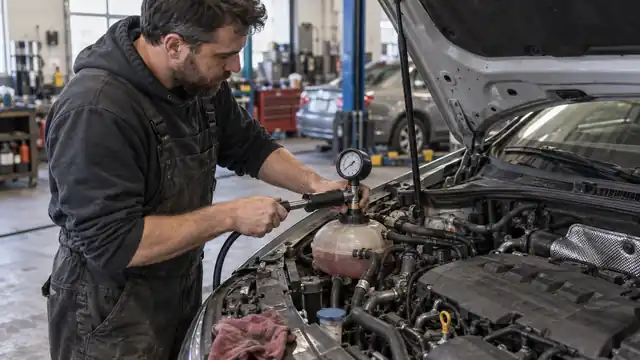
Clogged vs leaking heater core symptoms often overlap. A heater that blows cold air in winter does not automatically mean the heater core has failed. The same complaint can come from low coolant, trapped air, a thermostat problem, a closed heater valve, a restricted cabin filter, a weak blower, or an HVAC blend-door fault. Even when the heater core is responsible, the correct repair depends on whether it is clogged or leaking.
This guide explains how technicians separate those two failure modes, which checks should be completed before replacement, and what fitment details matter when selecting a heater core assembly.
What Does a Heater Core Do?
The heater core is a compact heat exchanger installed inside the HVAC housing, usually behind the dashboard. Hot engine coolant enters through one pipe and exits through another. When cabin heat is requested, the blower moves air across the core’s fins, and the HVAC doors direct that warmed air into the cabin.
Because the heater core belongs to both the engine cooling circuit and the cabin HVAC system, a fault can produce engine-bay, dashboard, windshield, or footwell symptoms. That overlap is why diagnosis should follow a sequence instead of relying on one symptom.
Clogged vs Leaking Heater Core: Quick Comparison
| Observation | More Consistent With a Clog | More Consistent With a Leak | How to Confirm |
|---|---|---|---|
| Cabin heat | Weak or absent after warm-up | May stay warm until coolant loss reduces circulation | Verify engine temperature, airflow, blend door, and hose temperatures |
| Coolant level | Often stable | May fall gradually | Check cold and pressure-test to specification |
| Odor and glass | Normally no sweet odor or oily film | Sweet odor, recurring windshield haze | Inspect vents, glass, HVAC case, and footwell |
| Heater hoses | Inlet hot while outlet is noticeably cooler | Difference may be normal or irregular if coolant is low | Compare both under identical conditions |
| Passenger carpet | Normally dry | Dampness or coolant residue may appear | Identify the fluid and rule out rainwater or A/C condensate |
Symptoms of a Clogged Heater Core
A restriction limits coolant flow through the small passages inside the core. Common causes include degraded coolant, mixed or incorrect coolant chemistry, corrosion products, mineral deposits, and particles from deteriorating cooling-system components. Sealant products can also collect in narrow passages.
- Little or no cabin heat after the engine reaches operating temperature.
- Heat that improves temporarily when engine speed increases.
- A hot heater-core inlet hose and a substantially cooler outlet.
- Discolored coolant or contamination elsewhere in the system.
- No clear evidence of coolant loss inside the cabin.
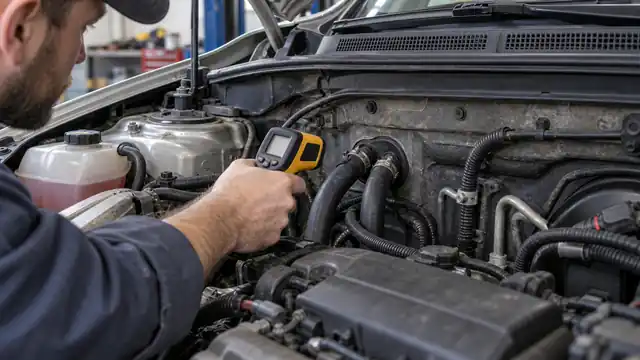
A temperature difference is useful evidence, not a universal pass/fail number. Hose material, ambient temperature, engine load, blower speed, vehicle design, and measurement location all affect the reading. A cool outlet can also result from a closed heater valve or an air pocket.
Symptoms of a Leaking Heater Core
A leaking core allows coolant to escape inside the HVAC housing. A small leak may evaporate on the warm core before it forms a visible puddle, making the loss difficult to locate.
- A sweet coolant odor from the vents.
- A recurring greasy film on the inside of the windshield.
- Dampness, staining, or sticky residue in the front passenger footwell.
- Coolant level that slowly falls with no obvious engine-bay leak.
- A cooling-system pressure test that loses pressure while coolant appears near the HVAC case or drain.

Do not identify fluid by smell alone. Water can enter through a blocked A/C evaporator drain, door or windshield seal, or body drain. Coolant may feel slightly slippery and have a distinctive color, but a controlled pressure test and visual inspection provide better evidence.
A Practical Diagnostic Sequence
1. Confirm coolant level and engine temperature
Begin with a cold engine. Check coolant level and condition, then inspect the reservoir, radiator area, hoses, water pump, thermostat housing, and visible connections. Confirm the engine reaches the manufacturer’s specified temperature. An engine that runs too cool may never supply enough heat to the core.
2. Rule out airflow and control faults
Confirm the blower changes speed, airflow is not restricted by a loaded cabin filter, and the temperature blend door moves through its full range. If the vehicle has a coolant control valve, verify that it opens when heat is requested.
3. Compare inlet and outlet temperatures
With the cooling system full and the engine at operating temperature, compare both heater hoses at consistent points near the firewall. Two warm hoses with poor cabin heat point toward airflow or air-mixing controls. A hot inlet and cooler outlet can indicate restricted flow, but first consider the heater valve and trapped air.
4. Pressure-test the cold cooling system
Fit the correct adapter and bring the system only to the pressure specified for the vehicle. Watch for a pressure drop and inspect external components as well as the HVAC housing, drain, carpet, and lower dashboard area. Never exceed the specified test pressure.
5. Decide whether flushing is appropriate
Some manufacturers allow a restricted heater core to be flushed using an approved procedure. Others recommend replacement, especially for narrow flat-tube heat exchangers or severe contamination. Avoid generic stop-leak products because circulating material may obstruct other small passages.
When Should the Heater Core Be Replaced?
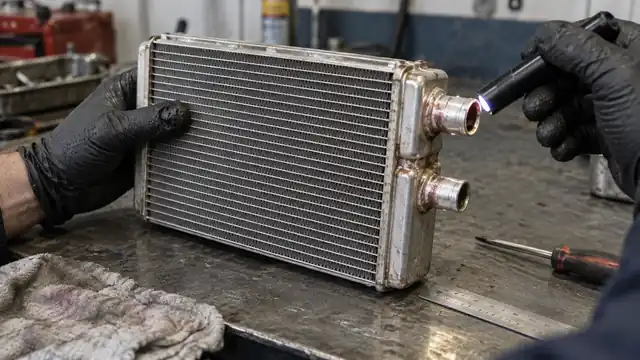
Replacement is generally appropriate when an internal leak is confirmed, tubes or end tanks are corroded or damaged, or an approved flushing procedure cannot restore adequate flow. It may also be required when system contamination has damaged the core or the vehicle manufacturer specifies that the heat exchanger should not be flushed.
Labor can be significant because many vehicles require partial or complete dashboard removal. Before authorizing that work, document the diagnosis. After removal, inspect nearby pipes, clamps, seals, HVAC drains, evaporator area, and insulation so a separate leak is not mistaken for a failed core.
Heater Core Fitment Checklist
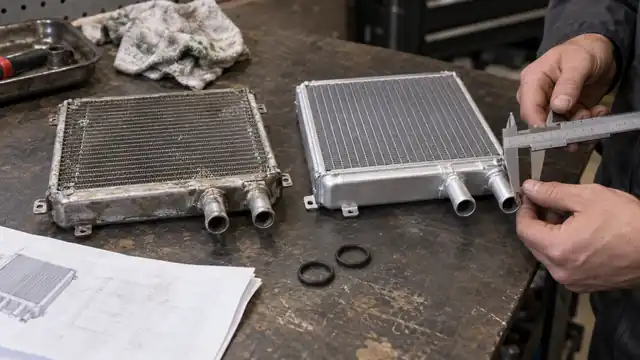
A heater core that looks similar in a catalog may still be wrong for the HVAC case. Confirm fitment with vehicle data and the removed unit:
- OE or reference number: Cross-check supersessions and application notes.
- Vehicle details: Confirm model, year, engine, production date, and VIN variation.
- Steering position: LHD and RHD cases may use different pipe layouts.
- Core dimensions: Compare height, width, thickness, and tank position.
- Pipe geometry: Check diameter, spacing, length, bend direction, and connection style.
- Mounting features: Verify tabs, brackets, grooves, clips, and foam seals.
- Hardware: Identify whether O-rings, clamps, seals, or pipes are supplied.
Checks After Installation
Clean coolant from the HVAC housing, ducts, carpet, and windshield so old residue does not create a false leak complaint. Install new seals and O-rings where specified, use the correct coolant type and mixture, and refill or vacuum-fill according to the vehicle procedure. Air must be bled completely.
Finally, pressure-test the system, warm the engine, verify stable engine temperature and even vent heat, compare the heater hoses, and check for leaks after cool-down. Recheck coolant level only when cold.
Frequently Asked Questions
Can a clogged heater core cause engine overheating?
Not always, because it is only one branch of the cooling circuit. However, contamination or low coolant associated with the restriction may also affect the radiator, thermostat, water pump, or coolant passages.
Will flushing always fix a clogged heater core?
No. Flushing may restore flow when loose deposits are the cause and the manufacturer permits it. It cannot repair corrosion, a leaking seam, crushed tubes, or severe hardened blockage.
Can a heater core leak without making the carpet wet?
Yes. A small leak can evaporate inside the HVAC housing or drain outside. Coolant odor, windshield film, gradual coolant loss, and pressure-test results may reveal it earlier.
Why is the heater cold if both heater hoses are hot?
Inspect the blower, cabin filter, blend door, actuator, temperature-control system, and foam seals. Air may be bypassing the hot core or not moving through it.
Can I bypass a leaking heater core?
A temporary bypass may stop coolant entering the cabin, but it removes cabin heating and can reduce windshield defogging performance. It is not a proper long-term repair.
Technical reference: HELLA Tech World guidance on cooling-system checks, heater performance diagnosis, pressure testing, flushing, and bleeding. Always prioritize the vehicle manufacturer’s current repair information.