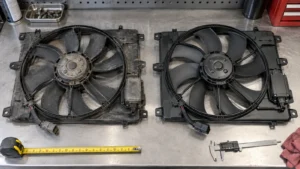
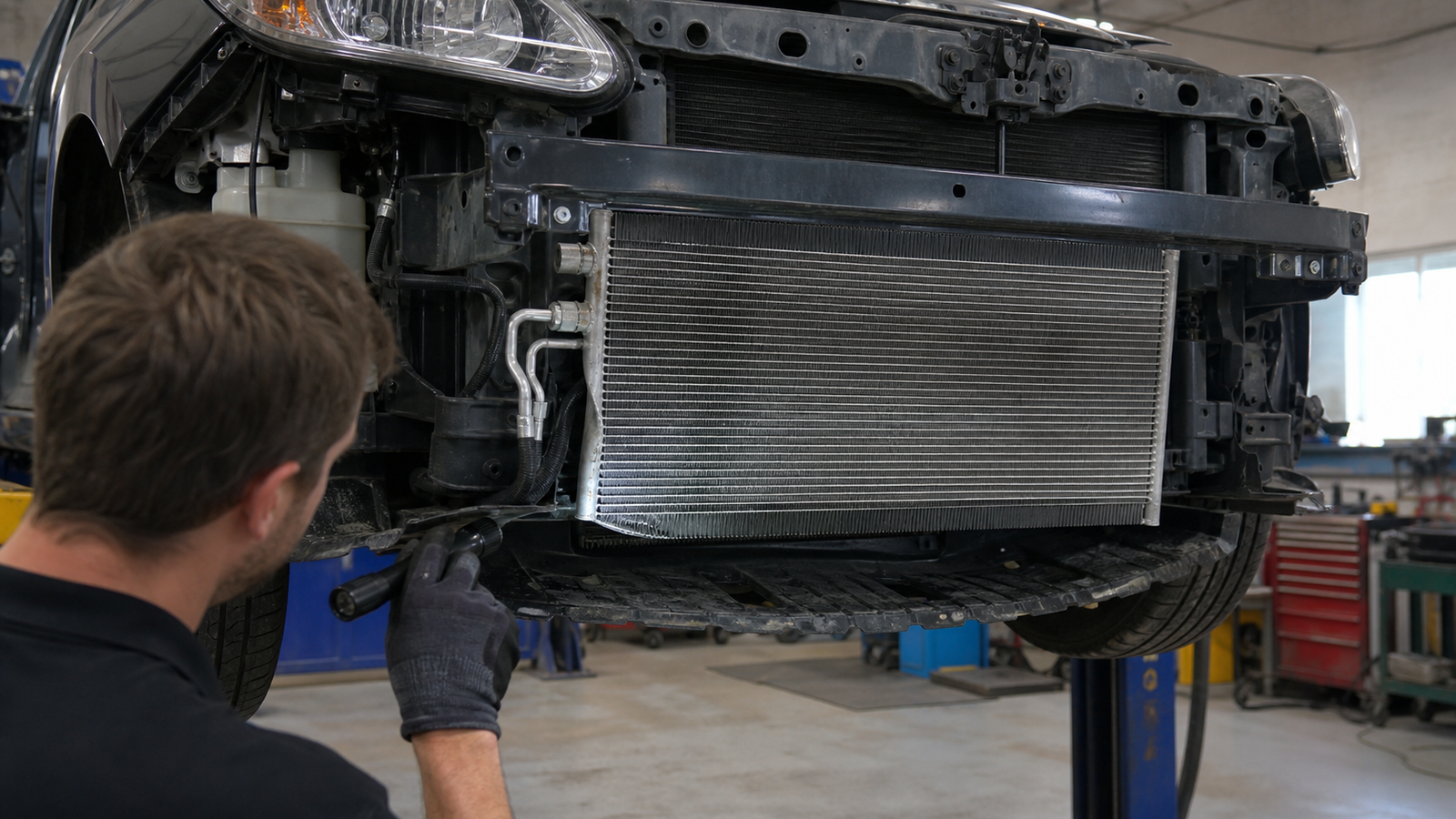
After a front-end impact, the first visible damage may be a cracked bumper or bent grille. Behind those panels, however, several thin heat exchangers can be compressed together. Two of the most commonly confused parts are the engine radiator and the A/C condenser. They may look similar, but they carry different fluids, fail in different ways and require different service procedures.
This guide explains radiator vs A/C condenser damage, how each component works, what symptoms appear after a collision, which inspections help identify the failed part, and what fitment details must be confirmed before ordering a replacement.
Radiator and A/C Condenser: What Is the Difference?
The radiator is part of the engine cooling circuit. Hot coolant leaves the engine and flows through tubes in the radiator core. Air moving through the fins removes heat before the coolant returns to the engine. DENSO’s radiator overview explains that the radiator relies on vehicle airflow and electric cooling fans, and that its performance is affected by other heat exchangers positioned in the same airflow path.
The A/C condenser belongs to the refrigerant circuit. High-pressure, high-temperature refrigerant gas from the compressor enters the condenser, releases heat to outside air and changes into a high-pressure liquid. According to DENSO’s condenser description, the condenser is normally located at the front of the vehicle and must withstand high internal pressure.
On many vehicles, airflow meets the A/C condenser first and the radiator second. The condenser is usually thinner and has aluminum refrigerant fittings. The radiator is often thicker, has large coolant hose connections and may use molded plastic side or top tanks. The exact arrangement varies, especially on turbocharged, hybrid and electric vehicles.
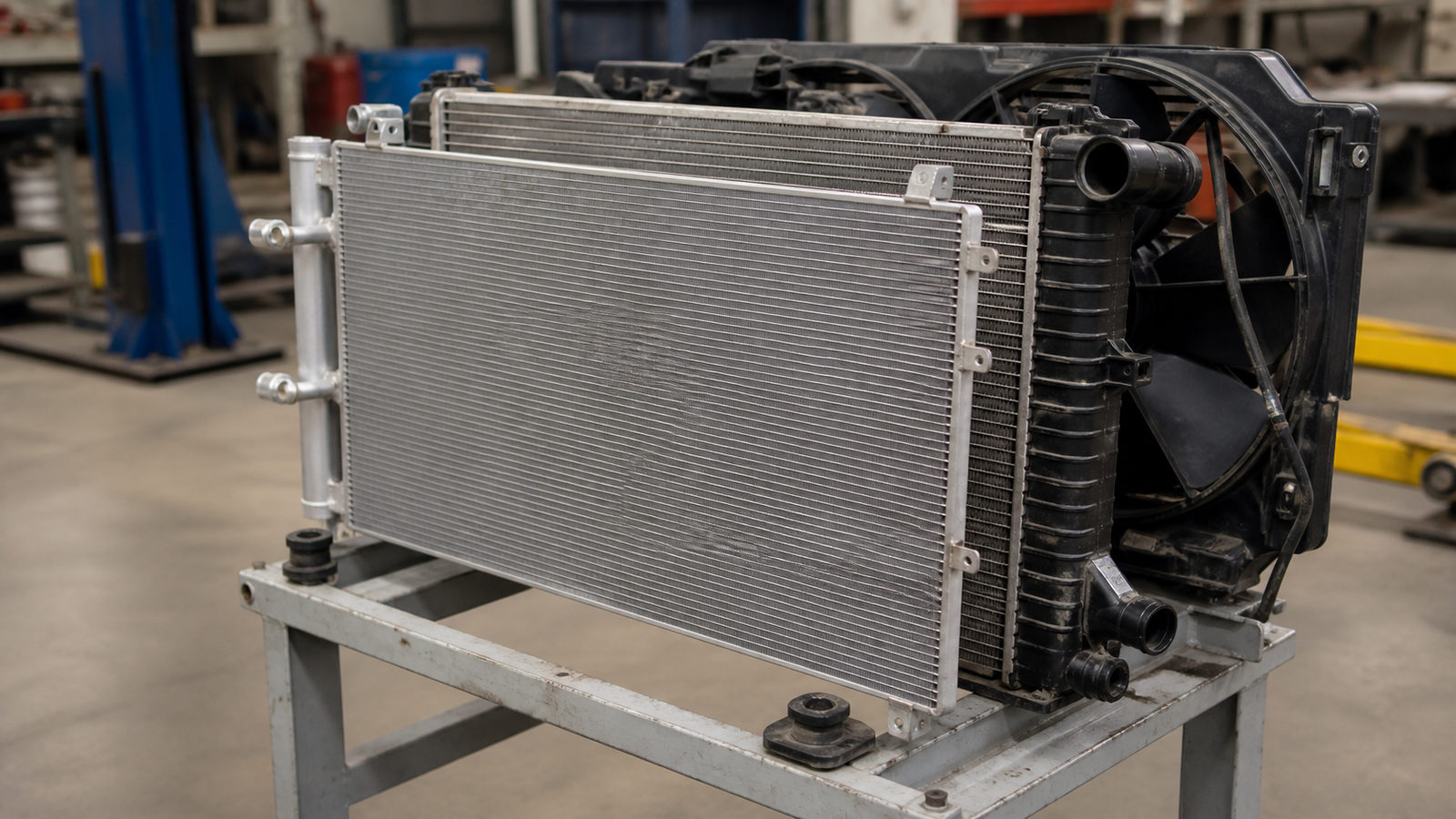
Quick Comparison: Which Part Is Damaged?
| Check | Radiator damage | A/C condenser damage |
|---|---|---|
| System affected | Engine or powertrain cooling system | Cabin air-conditioning refrigerant circuit |
| Common symptoms | Coolant loss, overheating, warning message, heater output changes | Weak or no A/C cooling, low refrigerant pressure, compressor disabled |
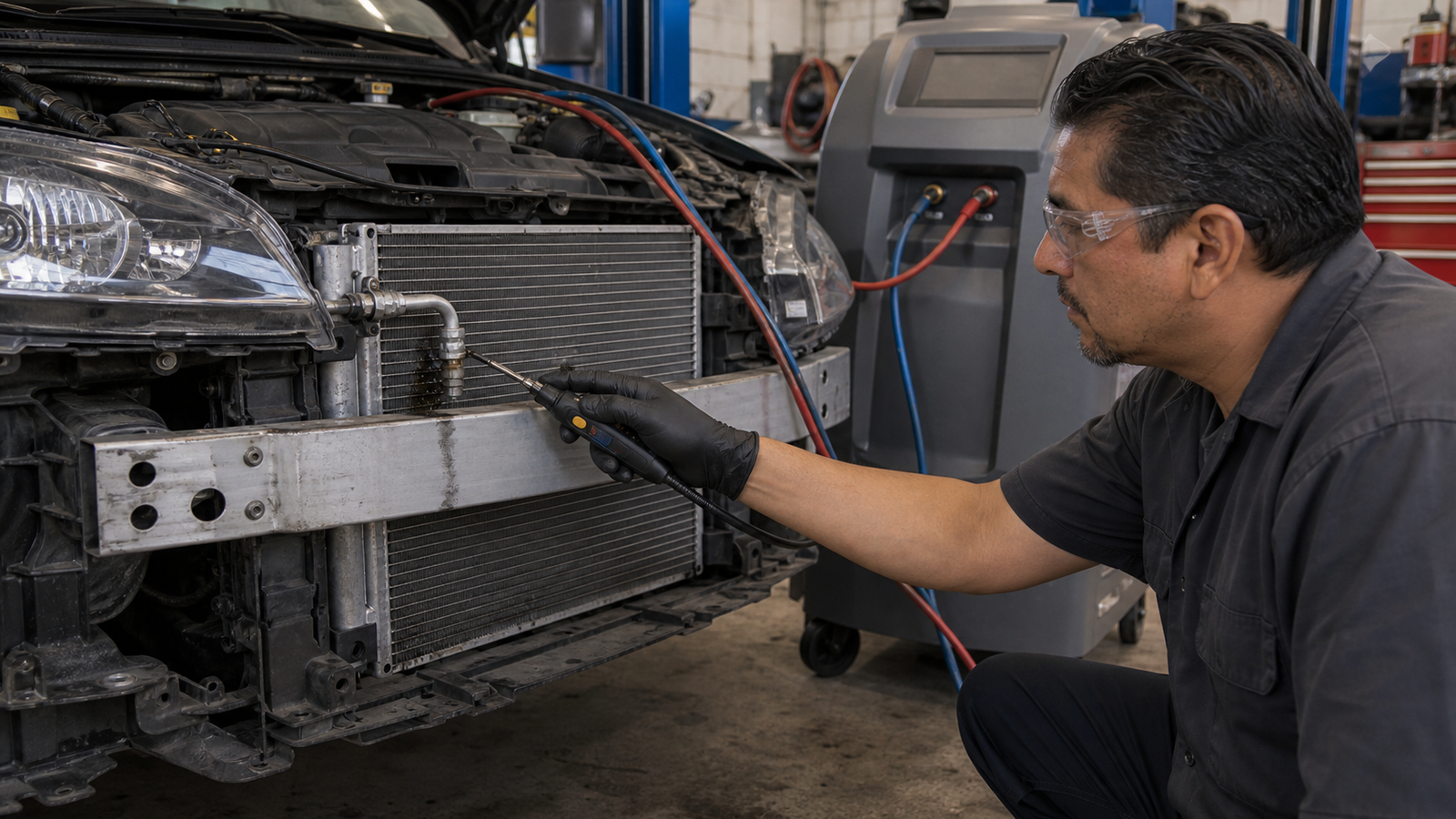
| Leak evidence | Colored or crusted coolant residue, wet plastic tank, hose neck or core seam | Refrigerant-oil staining, electronic detector response or approved UV dye evidence |
| Typical connections | Large coolant hose necks; possible transmission-oil cooler fittings | Smaller aluminum high-pressure refrigerant line fittings |
| Service requirement | Cool only, relieve pressure, drain and refill with specified coolant | Identify and recover refrigerant with approved equipment before opening |
Start With the Entire Front Cooling Stack
Do not inspect only the first damaged surface. A low-speed impact can push the condenser into the radiator without producing an immediate leak. It can also bend the radiator support, fan shroud, active grille shutters, charge-air cooler, oil cooler, hoses, pressure sensors or mounting brackets.
Nissens’ collision-damage guidance emphasizes that even light front impacts can deform heat exchangers, crack plastic radiator tanks, damage condenser tubes and disturb associated lines, sensors and brackets. A fan assembly that was struck or shifted can later contact the radiator or condenser.
Before running the vehicle, check:
- Radiator support and front body structure alignment
- Clearance between condenser, radiator and cooling fan
- Broken isolators, brackets, pins and mounting tabs
- Crushed tubes, folded fins and bowed cores
- Coolant hoses, refrigerant lines and electrical connectors
- Fan blade damage and free rotation with the system safely powered down
- Active grille shutters, air guides and seals that control airflow
A core that is visibly bowed may still be leak-tight during a quick inspection, but internal tubes can be restricted and mounts can remain under stress. The decision must consider leakage, airflow, heat-transfer capacity and mechanical alignment.
Signs the Radiator Was Damaged
Radiator damage most often shows as coolant loss or reduced cooling capacity. Look for a wet core, colored residue, white or crusted deposits, a split plastic tank, a cracked hose neck or separation where the core is crimped to the tank. Coolant may collect on the splash shield and drip somewhere away from the actual leak.
Other warning signs include rising engine temperature, a low-coolant warning, steam, a sweet coolant odor or a cooling fan that runs unusually often. Stop the engine if the temperature rises or coolant is escaping. Continuing to drive can turn a replaceable heat exchanger into serious engine damage.
A cold-system pressure test can help locate a small leak, but the correct test pressure and adapter are vehicle-specific. Excess pressure can create damage. The technician should also inspect the cap, expansion tank, hoses, thermostat housing and water pump because not every post-collision coolant loss comes from the radiator.
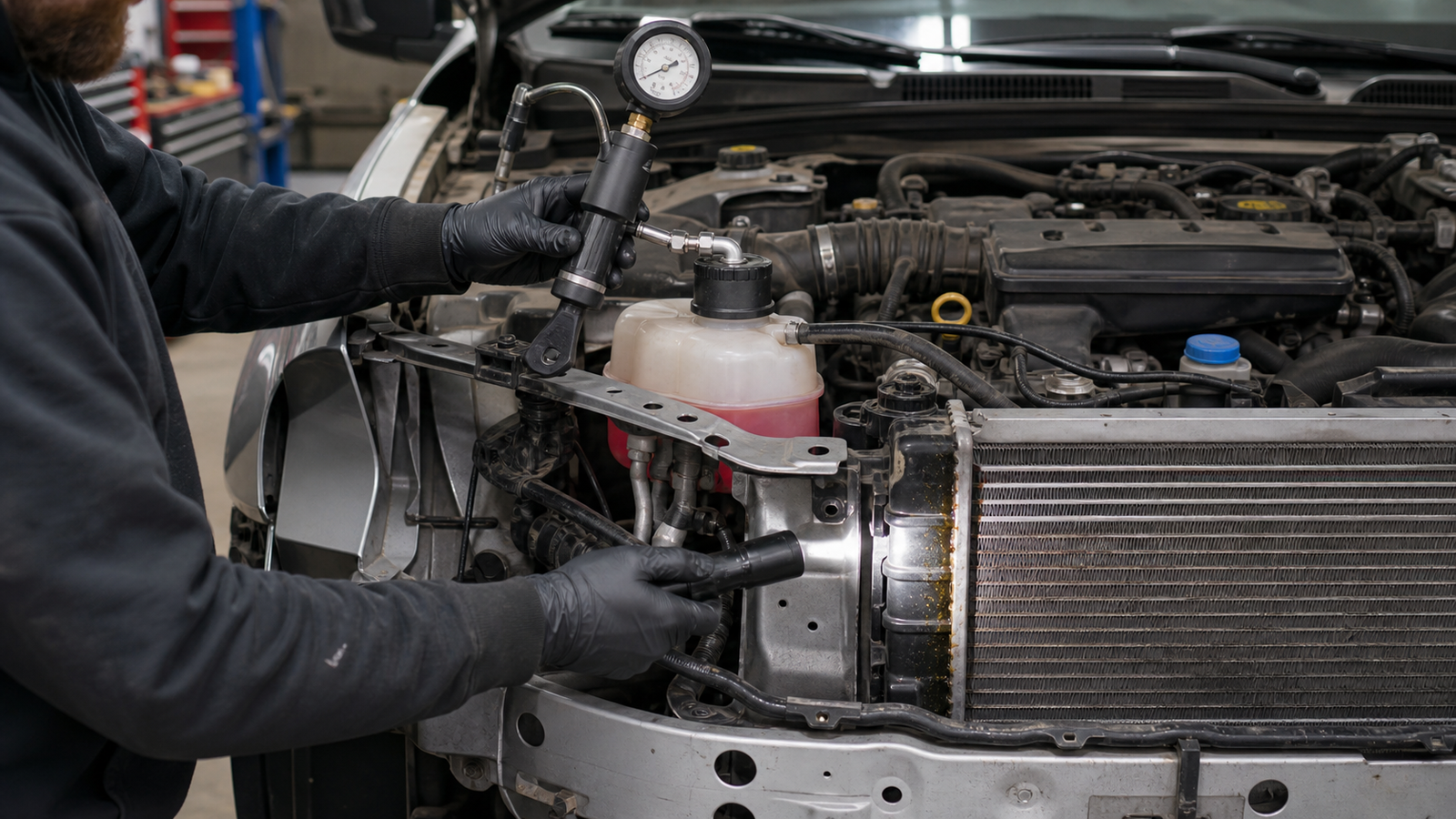
The MAHLE vehicle-cooling guide lists poor cooling, increased engine temperature and coolant loss after stone or accident damage among radiator failure indicators. It also recommends checking external contamination, damage, leaks and coolant condition.
Signs the A/C Condenser Was Damaged
Because the condenser is commonly the forward heat exchanger, it is highly exposed to stones and collision loads. A punctured tube or cracked fitting can release refrigerant quickly, causing weak or no cooling. The control system may prevent compressor operation when the measured pressure is too low.
Do not identify refrigerant by color or assume that every wet mark is a condenser leak. Refrigerant can escape as a gas, while compressor oil may leave a dark, dirt-catching stain near the leak. A qualified technician may use an electronic leak detector, approved UV dye already present in the system, pressure readings or another manufacturer-specified test.
The U.S. EPA’s motor-vehicle A/C service requirements state that refrigerant must not be intentionally vented and that certified recovery equipment must be used before service that could release it. Requirements differ by country, but controlled recovery and refrigerant identification are essential workshop practices.
Do Bent Fins Always Mean Replacement?
A few lightly bent fins from road debris do not automatically mean that a radiator or condenser must be replaced. Fins transfer heat but do not carry fluid. If tubes are straight, the core is not bowed, the unit is leak-tight and airflow remains adequate, minor fin damage may be serviceable using the approved cleaning or straightening method.
Replacement becomes more likely when:
- A tube is crushed, kinked, punctured or separated from a header
- The core is bowed and cannot mount without stress
- A radiator plastic tank, hose neck or core-to-tank joint is cracked
- A condenser fitting, manifold or integrated receiver-drier is damaged
- Large areas of fins and tubes are compressed, restricting airflow
- The cooling fan or neighboring heat exchanger has contacted the core
- The component fails the specified leak, pressure or performance test
Do not blast the core at close range with high-pressure air or water. Thin fins fold easily, and pushing debris deeper between stacked heat exchangers can reduce airflow. Separate components as specified and clean in the correct direction.
Why Both Systems Can Show Symptoms Together
The radiator and condenser share the same airflow. A condenser packed with debris or folded after an impact can restrict air reaching the radiator, contributing to high engine temperature at low speed. Likewise, a failed cooling fan can reduce both engine cooling and A/C performance.
This means “the A/C is warm” does not prove the condenser leaks, and “the engine overheats” does not prove the radiator leaks. Fan operation, air guides, grille shutters, coolant level, refrigerant pressure and the physical condition of the complete heat-exchanger stack must be considered together.
Replacement Fitment Details to Confirm
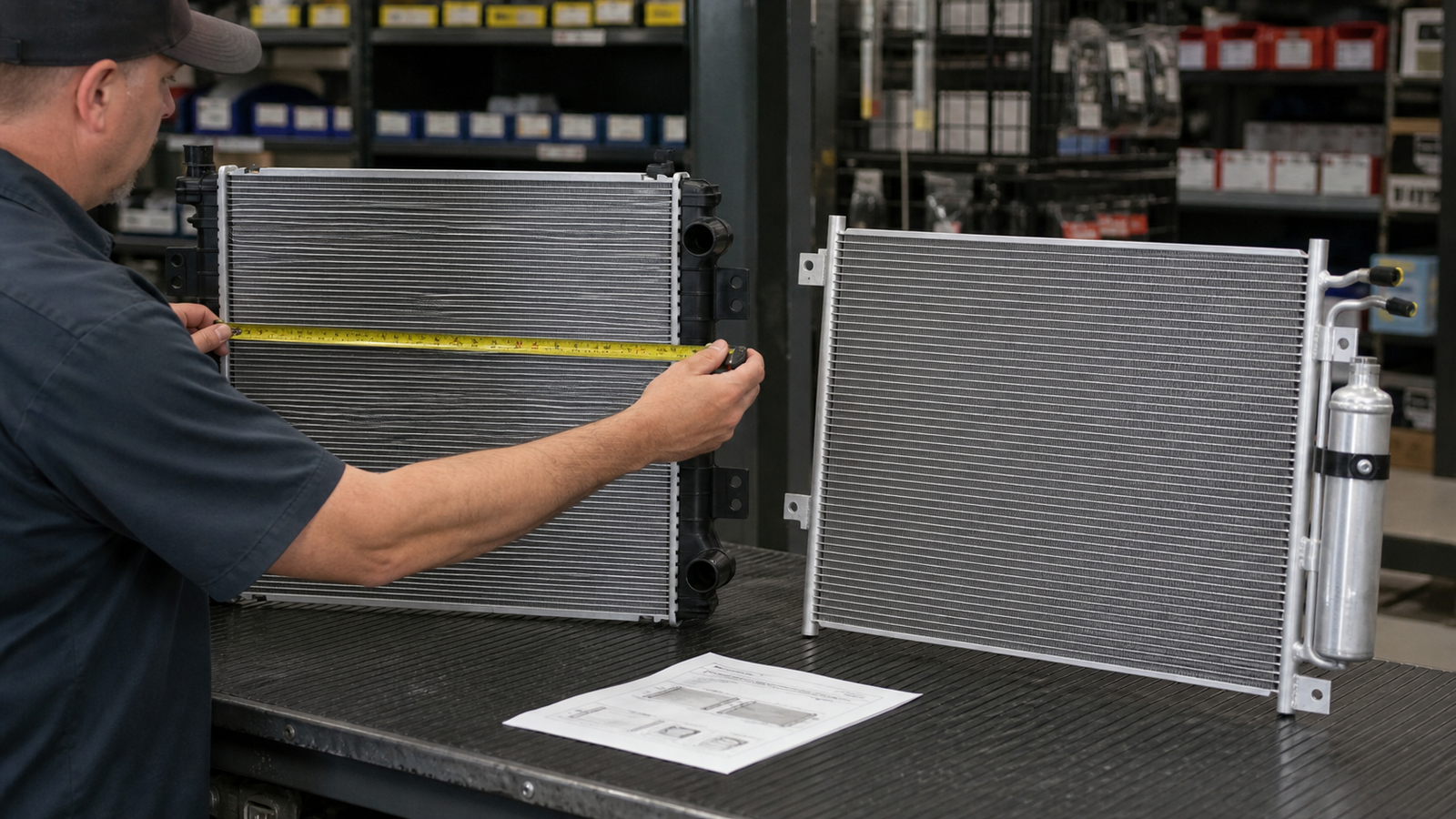
Radiators and condensers can vary within the same model year. Confirm the VIN, production date, engine, transmission, market and original equipment number. Photograph the original component before disposal, including every port, bracket and sensor.
Radiator fitment points
- Core height, width and thickness
- Upper and lower hose locations and diameters
- Mounting pins, side brackets and fan-shroud attachment points
- Automatic-transmission cooler fittings, where used
- Drain, temperature sensor and vent connections
Condenser fitment points
- Core dimensions and mounting tabs
- Inlet and outlet fitting positions and sealing type
- Pressure-sensor or line attachment points
- Integrated receiver-drier or modulator configuration
- Compatibility with the specified refrigerant and system design
Post-Repair Checks
After the front structure is correctly aligned and replacement parts are installed, confirm clearance between every heat exchanger and the fan. Refit air guides, seals and shutters so airflow passes through the cores rather than around them.
The cooling system must be refilled with the specified coolant and bled using the correct procedure. Check for leaks, stable temperature, heater operation and cooling-fan control. The A/C system requires evacuation, vacuum-hold evaluation where specified, the exact refrigerant and oil quantities, and a performance test by qualified personnel.
Frequently Asked Questions
Is the condenser always in front of the radiator?
It is commonly installed ahead of the radiator, but not universally. Some vehicles use multiple or indirect heat exchangers, especially hybrids and electric vehicles. Follow the parts diagram for the exact vehicle.
Can a bent condenser cause engine overheating?
Yes, if the deformation or debris significantly blocks airflow to the radiator. A damaged fan, missing air guide or closed active grille shutter can produce a similar combined symptom.
Can I drive with a leaking radiator after a minor collision?
No. Coolant loss can rapidly cause overheating and engine damage. Switch off the engine safely and arrange recovery rather than relying on repeated coolant top-ups.
Can a condenser be tested with ordinary shop air?
Use only the vehicle and equipment manufacturer’s approved test method. Uncontrolled compressed air can introduce moisture, exceed safe pressure or create a hazardous mixture. Refrigerant service requires the appropriate training and equipment.
Should the receiver-drier be replaced with the condenser?
It depends on the system design and service procedure. Many modern condensers integrate the receiver-drier. When the refrigerant circuit has been open or contaminated, the manufacturer may require drier replacement.
Find the Correct Radiator or Condenser Assembly
Send the VIN, OE number, production date, engine and transmission details together with front and rear photos of the original heat exchanger. Clear images of every connection and mounting point help confirm the correct replacement before shipping.