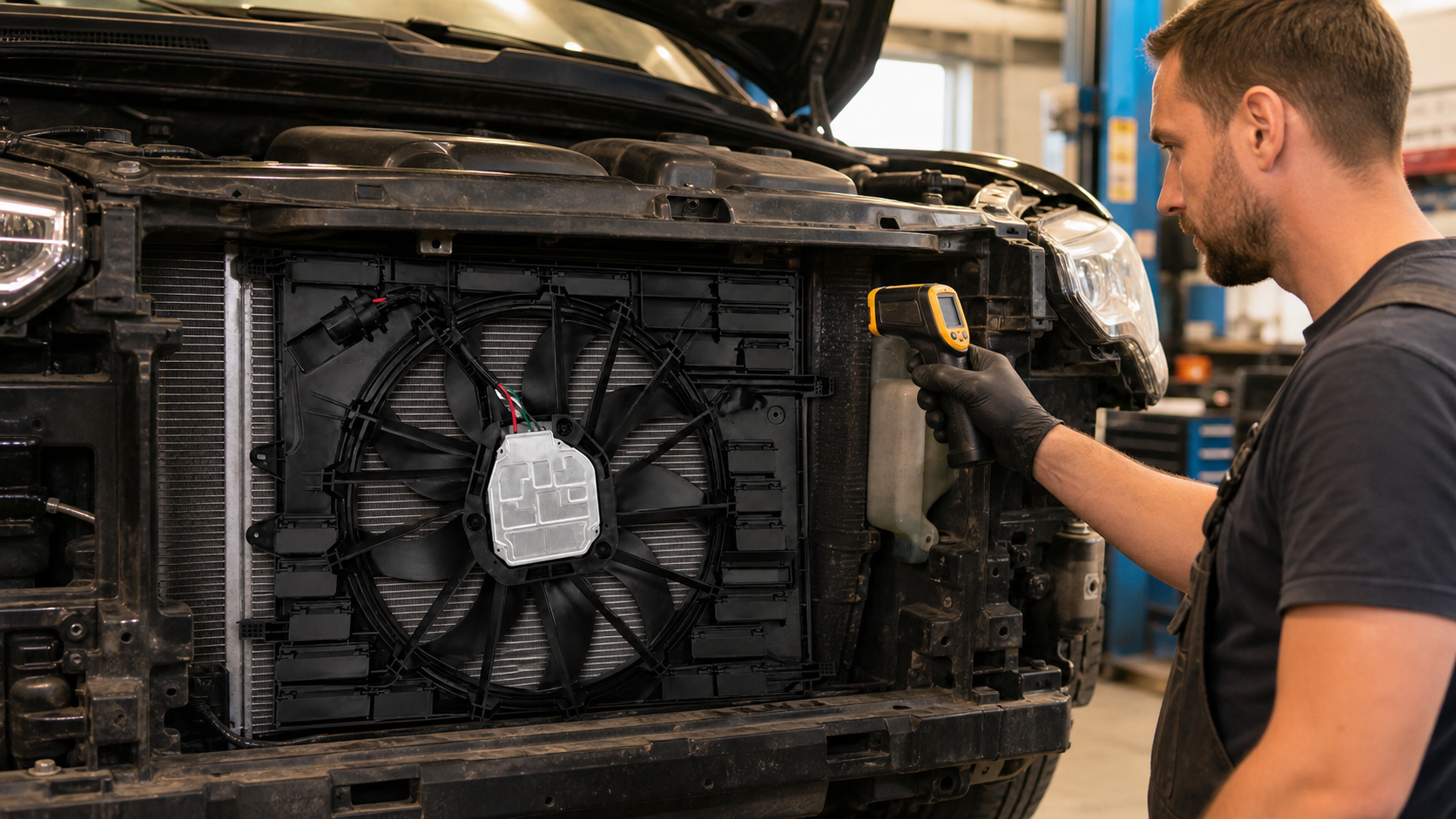
If your car overheats at idle but cools down while driving, the symptom points to an important clue: the cooling system may be able to remove heat when road speed forces air through the radiator, but not when the vehicle is stationary. A weak or non-operating radiator fan is the most common place to start, although low coolant, trapped air, a restricted radiator, thermostat trouble, or poor coolant circulation can produce similar behavior.
This guide explains what the symptom means, how to diagnose it in a logical order, and when a replacement cooling fan assembly may be required. It is written for repair shops, parts buyers, importers, and experienced DIY owners who want a practical fault-finding process.
Safety first: Stop the engine if the temperature warning light comes on, the gauge enters the red zone, steam appears, or coolant is being expelled. Never remove a radiator or expansion-tank cap while the system is hot. Electric fans can start without warning, even with the engine off, so keep hands, clothing, and test leads clear of the blades.
Why a Car Overheats at Idle but Not While Driving
A moving vehicle receives natural ram air through the grille, condenser, and radiator. At idle or in slow traffic, that airflow drops dramatically, so an electric cooling fan must pull or push air through the heat exchangers. DENSO explains that cooling fans are specifically used to prevent overheating when a vehicle is stationary by forcing air through the radiator.
That is why a temperature gauge that climbs in traffic and falls again at road speed often indicates an airflow problem. It is a strong diagnostic clue, but not proof that the fan motor itself is defective. The fan may be healthy while its fuse, relay, wiring, temperature input, control module, or command signal has failed.
Quick Symptom Guide
| Observed symptom | More likely cause | First check |
|---|---|---|
| Temperature rises only at idle or in traffic | Fan not running or airflow restricted | Verify fan command and actual operation |
| A/C becomes warm while stopped | Condenser/radiator airflow is too low | Check fan speed, fuse, relay, and module |
| Fan runs, but slowly or noisily | Worn motor, voltage drop, damaged blade, or resistance | Measure voltage at the connector and inspect the assembly |
| Temperature rises at idle and highway speed | Low coolant, thermostat, water pump, head-gasket, or severe restriction | Stop focusing only on the fan and test the entire cooling system |
| Gauge changes suddenly or does not match scan data | Sensor, wiring, instrument, or air-pocket problem | Compare live coolant-temperature data with an independent measurement |
Most Common Causes
1. The Radiator Fan Does Not Switch On
With the engine warm and the cooling system requesting fan operation, look and listen for the fan. Many vehicles also command at least one fan when the air conditioning is switched on, although the exact strategy varies by model and ambient conditions. If the fan remains still, do not immediately replace it. Check the fuse, relay, connector, ground, control signal, and relevant fault codes first.
2. The Fan Runs, but Airflow Is Weak
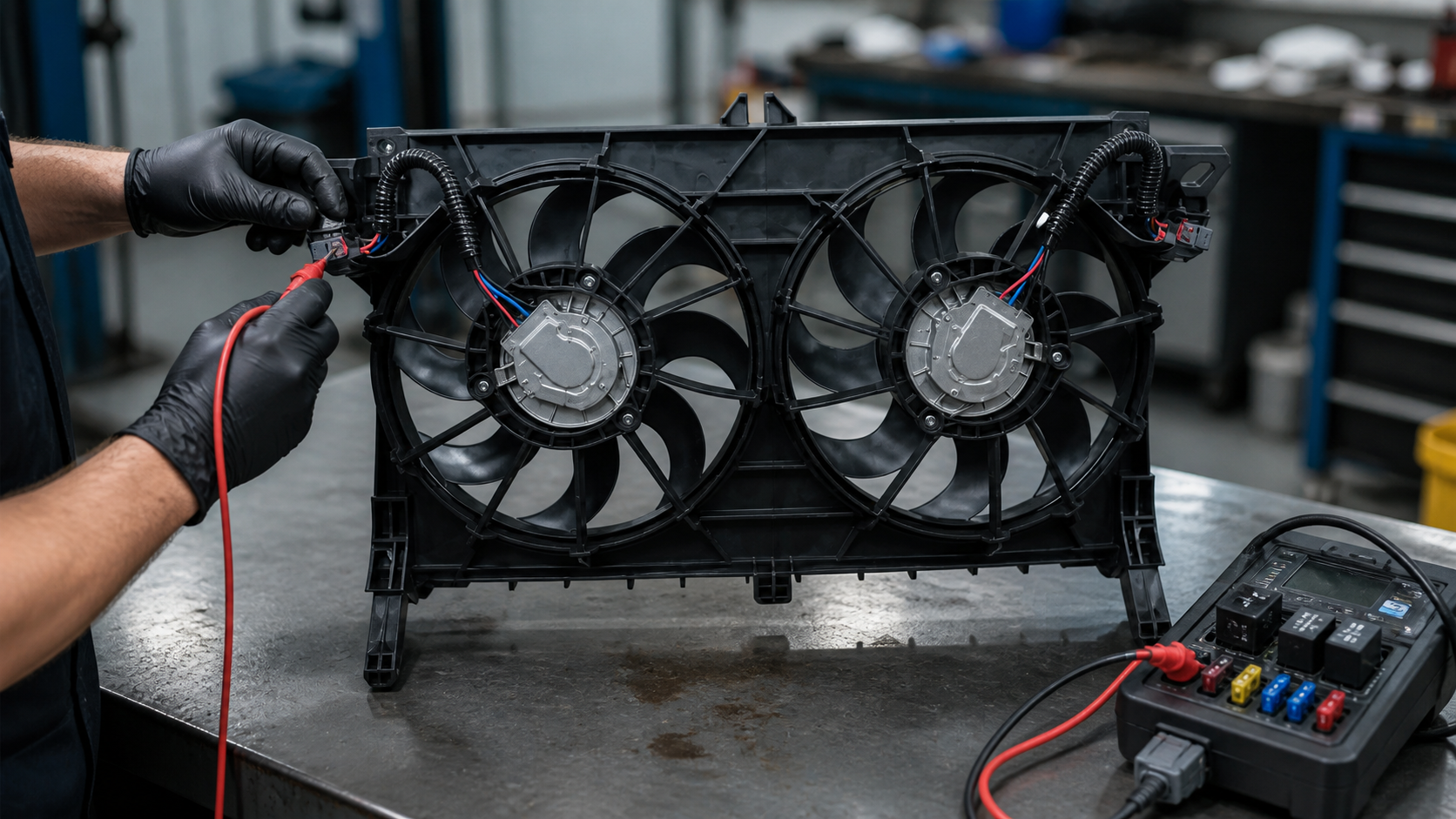
A worn motor can rotate without reaching the airflow required at idle. Voltage drop in the positive or ground circuit can have the same effect. Other possibilities include a damaged blade, incorrect replacement fan, reversed polarity after wiring repair, an incomplete shroud, or a fan that operates only at one speed when the system requires more.
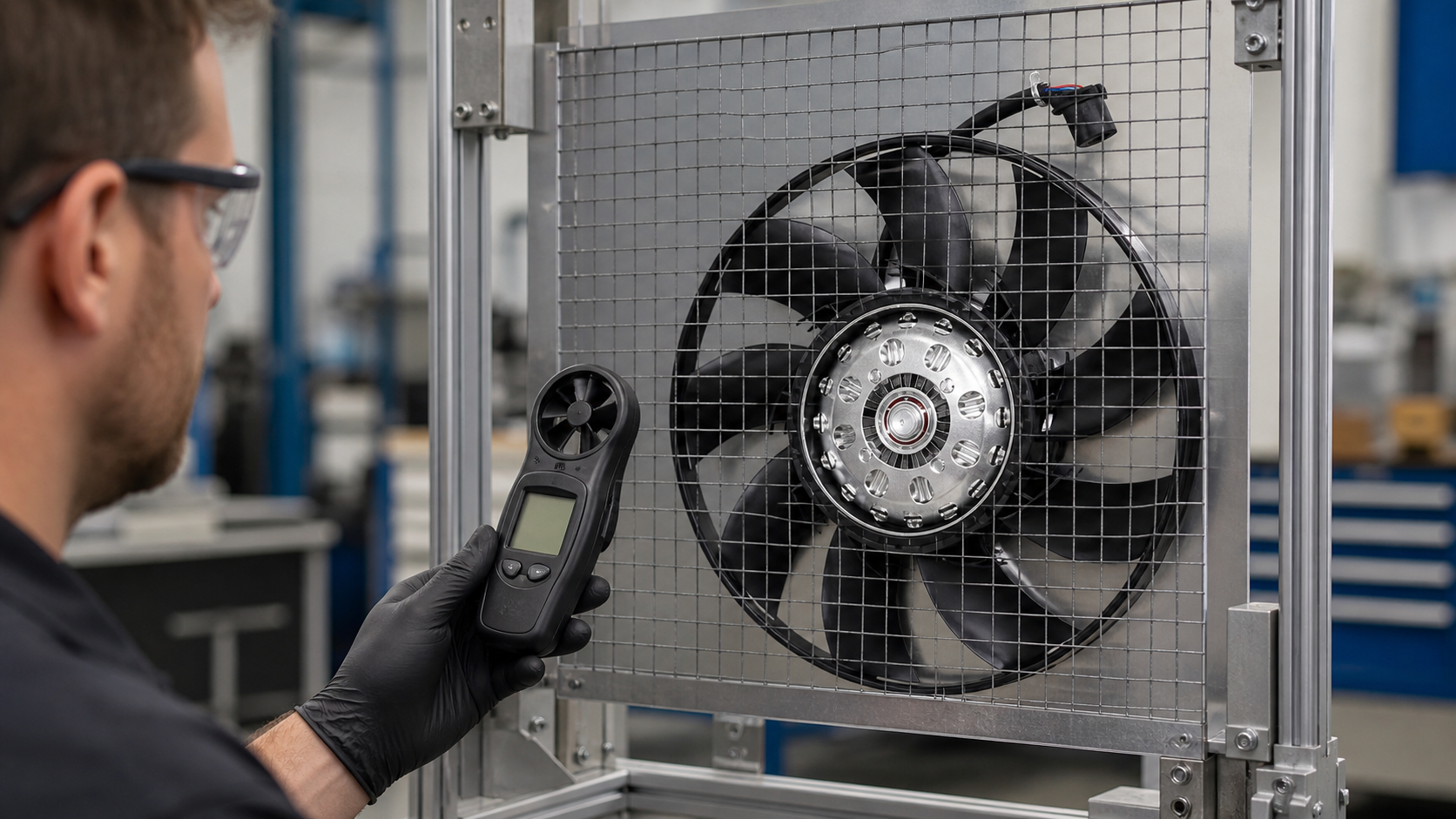
Do not judge performance by sound alone. Compare command, supply voltage, current draw, and measured airflow with the vehicle manufacturer’s service data. A direct-power test may prove that a conventional two-wire motor can turn, but it does not validate the vehicle’s control circuit, and it should never be improvised on a smart fan with integrated electronics.
3. Fan Relay, Wiring, Sensor, or Control Module Failure
Modern vehicles may use relays, pulse-width control, a dedicated fan module, or a module integrated into the fan assembly. According to a Gates technical sheet, a failed cooling-fan module can prevent the engine or A/C fan from activating efficiently and may lead to a hot-running engine, overheating, poor air-conditioning performance, or a warning light.
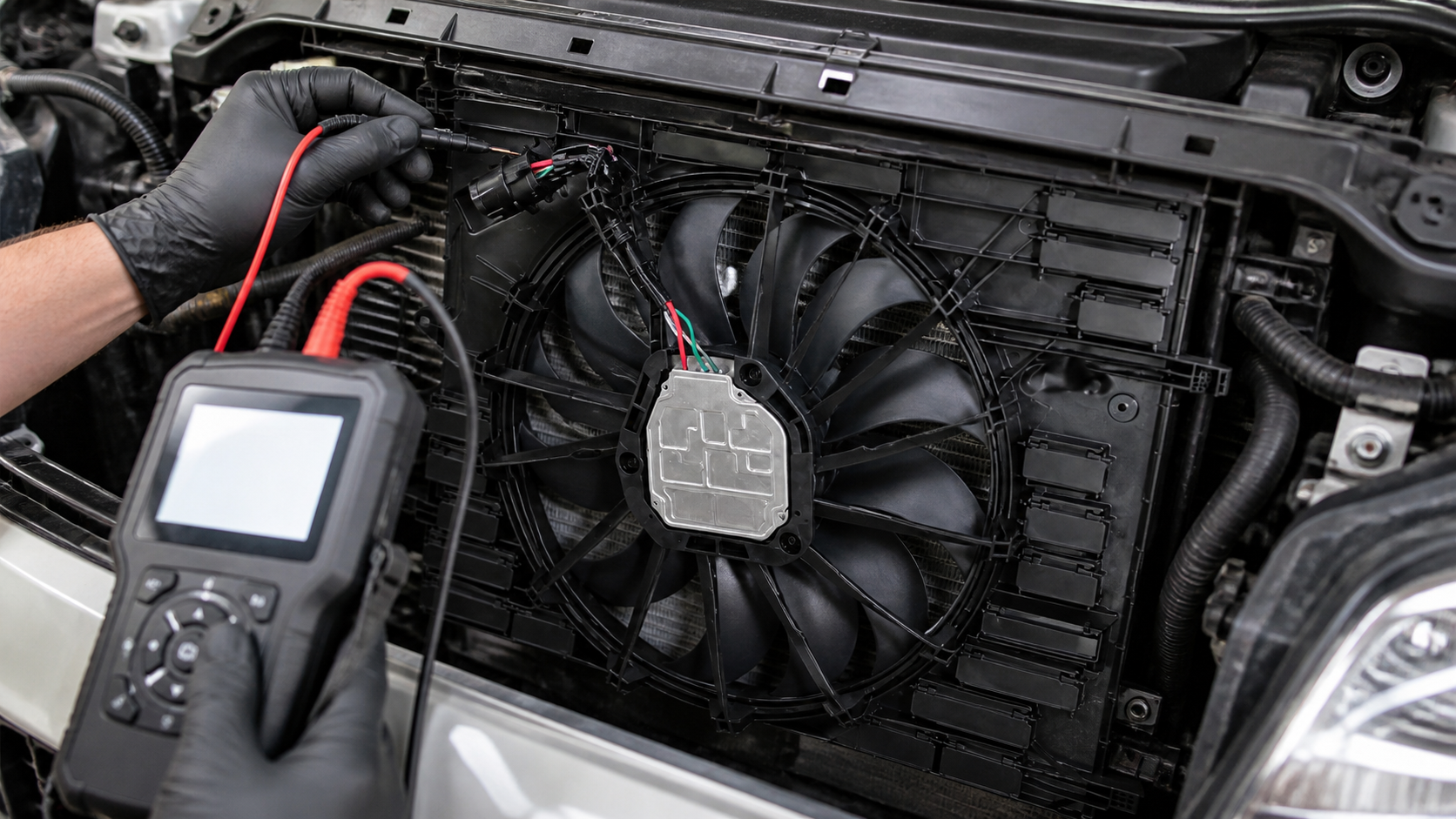
A useful professional test is to compare desired fan speed in scan data with actual operation. If the scan tool can command the fan but it does not respond, verify power and ground under load before condemning the motor or module. If the fan runs during an output test but never receives a normal command, investigate coolant-temperature data, pressure inputs, network faults, and control logic.
4. Radiator or Condenser Airflow Is Blocked
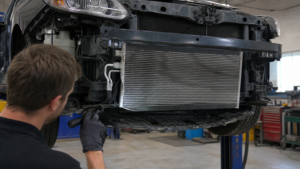
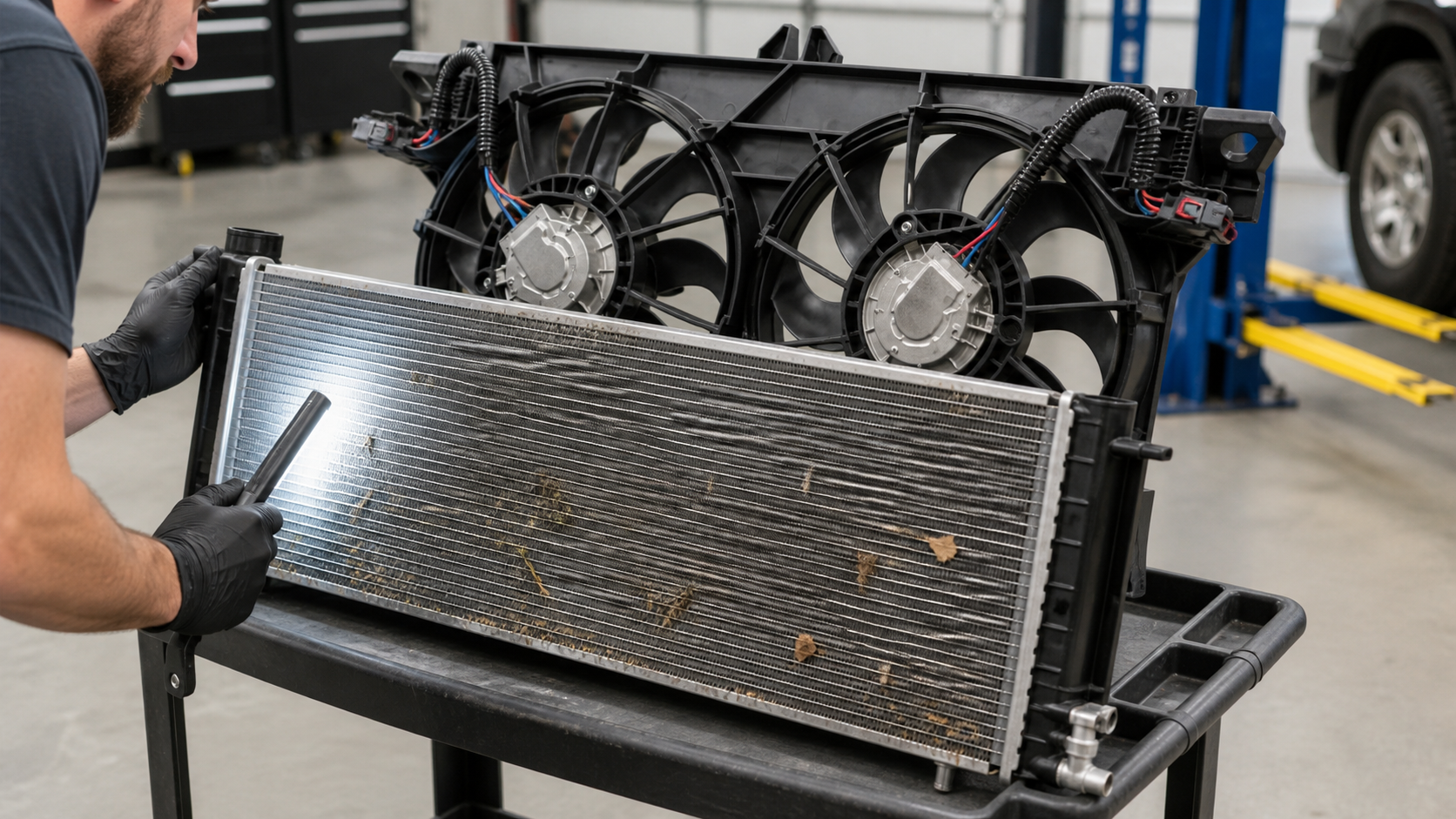
Leaves, plastic bags, insects, mud, dust, bent fins, or debris trapped between the condenser and radiator can reduce heat transfer. A missing seal or damaged shroud may also allow the fan to recirculate hot air around the radiator instead of drawing cooler outside air through it. Inspect both faces and the narrow space between the heat exchangers; the front surface can look clean while the hidden layer is restricted.
5. Low Coolant or Air Trapped in the System
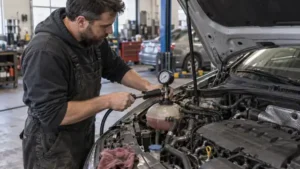
Low coolant reduces the system’s ability to transport heat and may prevent a temperature sensor from being fully immersed. An air pocket can also cause erratic gauge movement, weak cabin heat, local boiling, or poor circulation. Check the cold coolant level, pressure-test for leaks, and use the correct bleeding or vacuum-fill procedure for the vehicle. Never assume that topping up the reservoir repairs the reason coolant was lost.
6. Thermostat, Water Pump, or Internal Cooling Problem
A thermostat stuck closed blocks effective radiator flow; MAHLE notes that this can cause the engine to overheat. A damaged water-pump impeller, slipping drive, collapsed hose, blocked passage, combustion-gas leak, or heavily restricted radiator can also reduce coolant circulation. These faults are especially important when overheating continues at road speed, the heater output changes unexpectedly, or pressure builds rapidly from a cold start.
Step-by-Step Diagnostic Procedure
- Confirm the complaint. Record when the temperature rises: parked idle, stop-and-go traffic, A/C on, hill climbing, or highway driving. Note whether cabin heat and A/C performance change at the same time.
- Check coolant only when cold. Inspect the level, coolant condition, cap seal, hoses, reservoir, radiator, pump area, and underbody for leakage evidence.
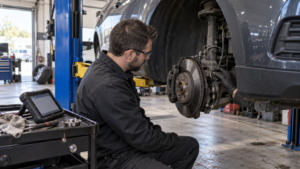
- Compare temperature data. Read engine-coolant temperature with a scan tool and compare it with an infrared measurement at appropriate cooling-system points. Follow manufacturer specifications rather than relying on one universal fan-on temperature.
- Observe fan operation. Verify whether the fan is commanded, whether all fans operate on a multi-fan system, and whether speed increases as required. Keep clear of the blades.
- Test the circuit under load. Inspect fuses, relays, grounds, connectors, heat damage, corrosion, pin tension, and voltage drop. A circuit can show battery voltage on a high-impedance meter yet fail when the motor draws current.
- Inspect the airflow path. Check condenser and radiator fins, seals, ducting, shroud fit, fan rotation direction, and the gap between heat exchangers.
- Test coolant circulation. If airflow is satisfactory, diagnose thermostat opening, radiator temperature distribution, pump operation, system pressure, trapped air, and possible combustion-gas intrusion using the correct service procedure.
When Should the Radiator Fan Assembly Be Replaced?
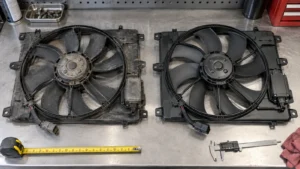
Replacement is justified when testing confirms an open or shorted motor, excessive current draw, weak airflow at the correct supply, damaged blades or shroud, seized bearings, an internally failed integrated control module, or a connector that cannot be safely repaired. On vehicles where the controller, motor, and shroud are supplied as one calibrated unit, replacing the complete assembly can reduce compatibility and airflow problems.
Match the replacement by VIN, OE number, connector, module type, mounting points, blade design, rotation, shroud dimensions, and single- or dual-fan configuration. A fan that physically fits is not automatically electrically or thermally correct.
Frequently Asked Questions
Can I keep driving if the car only overheats at idle?
No. Traffic, a long queue, or a hot day can quickly remove the airflow that is temporarily hiding the fault. Continuing to drive an overheating engine risks cylinder-head, gasket, turbocharger, hose, and catalyst damage. Arrange diagnosis before normal use.
Does turning on the A/C always make the radiator fan run?
Not on every vehicle and not under every condition. Fan strategy can depend on refrigerant pressure, coolant temperature, ambient temperature, vehicle speed, battery state, and module logic. Use model-specific service information and scan data.
Why does the A/C become warm at a red light?
The condenser also needs airflow. If the cooling fan is not operating correctly, refrigerant pressure and outlet temperature may rise while the vehicle is stationary, so warm A/C at idle can accompany engine overheating.
Can a bad thermostat cause overheating only at idle?
It can contribute, but a stuck-closed thermostat usually causes overheating under more than one driving condition. A problem that consistently improves as road speed increases makes radiator airflow and fan control a higher-priority first check.
Final Diagnosis Checklist
- Confirm when the temperature rises and whether A/C performance changes.
- Check coolant level and leaks only after the engine has cooled.
- Verify fan command, fan speed, fuse, relay, power, ground, wiring, and module operation.
- Inspect the condenser, radiator, seals, ducting, and shroud for lost airflow.
- If airflow is correct, test thermostat operation, coolant circulation, system pressure, and internal engine causes.
The key is to diagnose the system before buying parts. When the evidence confirms a fan assembly fault, choose a replacement that matches the vehicle’s electrical controls and airflow requirements—not just the external size.